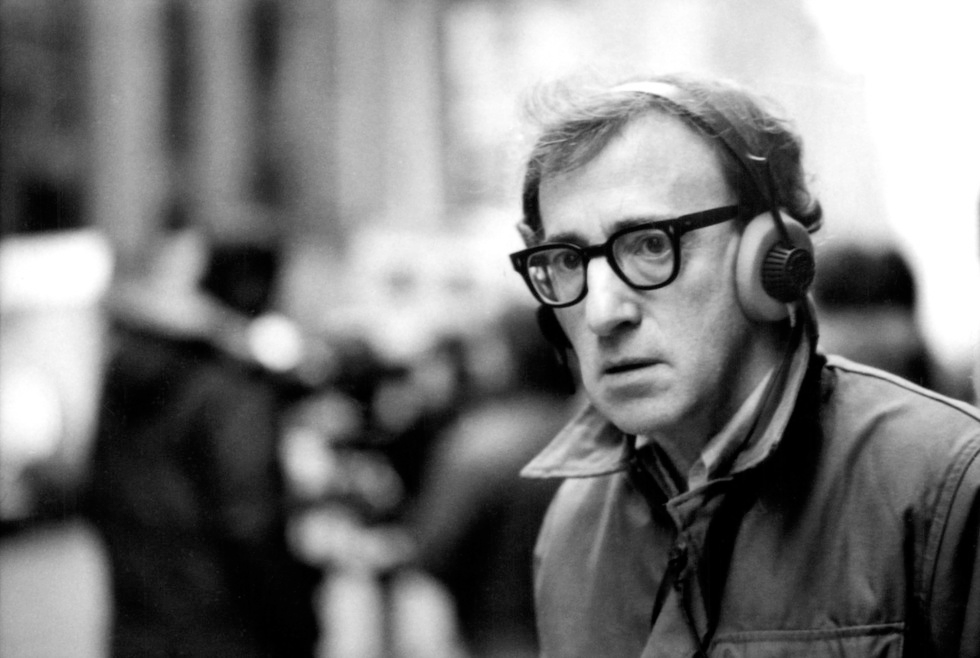
FILMOGRAPHY
Everything You Always Wanted to Know About Sex* *But Were Afraid to Ask (1972)
Love and Death (1975)
Annie Hall (1977)
Interiors (1978)
Manhattan (1979)
Stardust Memories (1980)
A Midsummer Night’s Sex Comedy (1982)
Broadway Danny Rose (1984)
The Purple Rose of Cairo (1985)
Hannah and Her Sisters (1986)
Radio Days (1987)
September (1987)
Another Woman (1988)
Alice (1990)
Shadows and Fog (1991)
Husbands and Wives (1992)
Manhattan Murder Mystery (1993)
Bullets Over Broadway (1994)
Mighty Aphrodite (1995)
Everyone Says I Love You (1996)
Deconstructing Harry (1997)
Celebrity (1998)
Sweet and Lowdown (1999)
Small Time Crooks (2000)
The Curse of the Jade Scorpion (2001)
Hollywood Ending (2002)
Anything Else (2003)
Melinda and Melinda (2004)
Match Point (2005)
Scoop (2006)
Cassandra’s Dream (2007)
Vicky Cristina Barcelona (2008)
Whatever Works (2009)
You Will Meet a Tall Dark Stranger (2010)
Midnight in Paris (2011)
To Rome With Love (2012)
Blue Jasmine (2013)
Magic in the Moonlight (2014)
Irrational Man (2015)
Cafe Society (2016)
Wonder Wheel (2017)
A Rainy Day In New York (2019)
Rifkin’s Festival (2020)
Coup de Chance (2022)
FILMOGRAPHICAL SUMMARY
The comedic genius Allen Konigsberg was born in the Bronx, in 1935, to Nettie and Martin Konigsberg, working class Jews of Austrian and Lithuanian descent. He was raised in Brooklyn, in the Midwood neighborhood, which would later be loosely rendered (and marvelously romanticized) in one of his masterpieces, Radio Days. At the age of only 17– still on the high school baseball team, sports one of Allen’s professed pleasures– his gags began to be featured in newspapers and his astonishingly effortless comedic gifts began to be noticed. Anticipating a career, he legally changed his name to more tolerably goy “Heywood Allen,” transmuted finally to “Woody Allen,” emerging as a perfectly digestible handle for a comedian in this occasionally anti-semitic America who did nothing at all to suppress his Jewishness.
He became, naturally, a comedic writer for television. He worked alongside a laundry list of the luminaries of the time. But first, young Woody (still only 19) flunked out of NYU’s film studies program, later a joke in his brilliant Annie Hall: “I was thrown out of N.Y.U. my freshman year for cheating on my metaphysics final. I looked within the soul of the boy sitting next to me.” Very soon, and throughout the 1960s, this shy, claustrophobic, introvert became one of the most unlikely and influential stand-up comics in the history of the form. As this is not a study of Allen’s life, I won’t dwell on this era except to say that he was every bit as good, if not better, in this first career. He changed the form, turned slender Greenwich Village stages into something approximating a psychoanalyst’s couch. So many of his bits are still uproariously funny and illuminating, still do, in fact, reverberate today without a trace of age.
The persona he developed as part of his routine was an exaggerated melange of self-effacement, insecurity, nebbishness, neuroticism, intellectualism, and so often used as its foundation the tenets of “schlemiel comedy” that has laced its way through Jewish humor for centuries.
Some time later, he took a class at Columbus Circle in a dumpy classroom with the Hungarian ex-pat-cum-drama-teacher, Lajos Egri. “There was no one in the class under forty-five years of age and nobody knew what they were doing…,” Allen later recalled. Allen’s gifts– as true creative gifts are– were in many ways inexplicable, natural, seemingly instantaneously developed. Yet it requires but one read through Egri’s “The Art of Dramatic Writing” to recognize the method, the clarity, concision, and sense of purpose that eventuated in the 50+ films he would proceed to write and direct over the next six decades. Aside from almost certainly being among the most practical books on dramatic writing ever written, listening to Allen talk about his films betrays its impact. In the documentaries and interviews on his career– including perhaps the best, that directed by Robert B. Weide, a staunch defender of Allen through his later “scandals”– Woody and his interlocutors practically speak of each film as if they are trying to distill the Egrian essence of each premise. The first two in the six theses Egri submits as the foundations of drama are:
- All human beings are fundamentally selfish, their primary drive being to feel, or be perceived as, important.
- Human character is fixed and does not change significantly over life.
At the intersection where these two premises collide with Allen’s demonstrable infatuation with Freudian psychoanalytics, Dostoyevsky, Kafka, existentialist philosophy, death, particular strands in the cinema (his near-deification of Ingmar Bergman and Fellini, for example), and romantic nostalgia might materialize some very uncertain Rubik’s Cube that could perhaps align and reveal his art.
But that, of course, would be too simple. Because all of those qualities Allen developed in the comedy houses also permeated his work. So what emerged was uniquely funny, and uniquely resonant, and came to typify his approach so deeply that both his persona and his work quickly grew inseparable.
He began to write prose, much of which was published in the New Yorker, beginning in 1969, and later in a few slender volumes: “Getting Even”, “Without Feathers,” and “Side Effects”. His voice was so singular that it was both instantly recognizable, inimitable (though many tried), and inevitable. That urge to ask: “why had no one thought to do it this way before?” That feeling which tends to pull the reader or viewer under the artist’s spell: Allen would later frame this ability, and its attendant questions, in dozens of ways in his films.
There were easily discernible qualities in Allen’s work that led to his explosive popularity. For an introvert, he was extremely candid and vulnerable. An example of a character trait that would later bite him in the ass, he was not at all squeamish about sex. In fact, he viewed sex as perhaps the principle gateway to the psyche and most fertile psychological grounds to traverse in his work (“I don’t know the question. But sex is definitely the answer.” ““Love is the answer, but while you are waiting for the answer, sex raises some pretty good questions.”) As a true bard would, he viewed sex and romantic love, naturally, as a universal domain of shared experience. In his standup, he used anecdotes and jokes about his own love life as a means of bringing his audience closer to his material. In his films he pushed these ideas into strikingly honest and potentially perilous places. Audiences thought they were getting closer, perhaps, to the true flesh and blood Woody. They may have been, but there is also this tendency to want to read autobiography into his material, because he was such an effective author of character.
This blending of fiction and fact is potentially also a consequence of the rare degree of respect he showed for the intelligence of his audience, readers, and viewers. He did not condescend and he did not soften the implications of his worldview. Even toss-away lines delivered by bit-part characters– “If Jesus came back and saw what was being done in his name, he’d never stop throwing up.”- stung. In his jokes were laughs such that the truth hurt. His comedy belied his nebbishness. It was actually often brutally honest: “Life is full of loneliness, suffering, and unhappiness, and it’s all over much too quickly.” “The most beautiful words in the English language are not, ‘I love you.’ They’re, ‘It’s benign.‘” “I believe there is something out there watching us. Unfortunately, it’s the government.” In Allen’s comedy was a sense of the human experience as mutually painful. That it not only could be, but must be, laughed at. Where he absented that comedy purposely was where Allen sailed into more uncertain seas, and the vessel he rode (almost always Bergman- or Dostoyevsky-inspired) tended to leave the sense of nihilism in its wake, in the form of his many heartlessly spurned and callously murdered.
So, compelled by this highly relatable and universal comedy, his best work was received not merely at face value, but at that kind of value that is accorded to things in which the receiver comes to digest into their marrow. Things that they come to “possess” as “their own”– that, as the cliche goes, “rewire” their perceptions. Allen’s films came to be not just films. Even though we’ll discuss his tendencies toward reinvention, his each release was attended by “Woody Allen Movie” expectations that went some way toward never affording his true experiments the appreciation they deserved.
It’s difficult for anyone born after 1990 to believe, but there was a time when one went to a Woody Allen film in order to go back to a sense of shared human experience, of real empathy. He achieved degrees of clarity, verisimilitude, and the stab of emotional truth in his characters in so many moments that it is difficult to find a film void of at least some interest. He was astonishingly brisk in his dramatic style, even though the structure of his plots could often be deceivingly complex. He achieved this, like a good comedian would, by building an emotional and/or comedic accumulation in his material. At the risk of vagueness, his best films blossomed. In his best films, what came next made all that came before more resonant. Ironically, given some vociferous accusations of sexism and of life choices he made that we will discuss (which broadened those claims), he was a dynamic chartist of the mores, charms, and vagaries of both sexes. As a man, he wrote so many dynamic women that if his critics sat and took both a deep breath and an accounting, they might calm.
How to reckon with his cinema? Why, though he made many cosmically wonderful films, did they seldom rise to the level of his cinematic idols? He made so many good films, that it seems each critic and fan has their own list of what they consider masterpieces and these are comprised of a startling number of films. Yet he is seldom spoken of with any degree of veneration. In his later career, one reason for this was rather obvious. But another key to this mystery could be his age and his working habits. He did not direct Annie Hall until he was 41 years old. He then proceeded to make films so quickly and consistently that it almost beggared sense. Like Bergman, Allen’s body of work is so massive that it consternates. Had he started his career with films (he certainly had the talent) it would be truly unwieldy. But these many works came less haphazardly than the troubled, workaholic Bergman. His energies– both physical and creative– kept with an idiosyncratically ordered and routine pace. He struck very few true lows, but neither did he allow himself the kind of creative madness that accidentally congeals into those astonishing highs he so admired. As mentioned, he was endlessly reinventive, but only as he reframed work that was, for more sterling artists, once the brazen stabs of risktakers. Allen took few true risks. He was simply working too quickly. Later, as his perceptive abilities weakened, the “film-a-year” Allen seemed to be churning out pictures in almost obligatory fashion.
His directorial career began in earnest in 1969, naturally, as a comedian, by making his “early funny movies”. In 1977, he pivoted, and declared with one of his greatest films that he’d found his true calling. From this point, one lens through which to view his work is through the series of cinematographers with whom he collaborated to greater or lesser success.
Those early comedies necessarily ran through a series of adequate professionals who didn’t get in the way of the laughs.
Then from 1977’s Annie Hall until 1985’s The Purple Rose of Cairo, Gordon Willis’ contribution simply cannot be overstated. It is not unreasonable to argue that these were, in their totality, “Allen/Willis films.” Willis was an artist of austere perfectionism and he influenced Allen’s every decision, even the very blocking of scenes. He accelerated Allen’s cinematic growth-curve so much that it is not too much to say that the contours of Allen’s career would have been totally different without his contribution. There was in these films sense of where things “should be”, more than ever a sense of “mise en scene” and its constituent parts, that Allen would achieve with no other cinematographer. This frequently resulted in images of such compositional and luminous beauty that certain shots could double as museum pieces. “The Prince of Darkness” as he came be called, Willis was a lunatic with light. If he was to have a coin of it at a precise moment fall on the forehead of an actor, it would be because they hit their fucking mark. But he was austere even with that very light, most notably in Interiors. He made you strive to see, to lean in and look more closely. When Black & White was considered anathema, Willis completely reimagined its usage and impact. These images seemed set in a mythic past, a storybook history of New York. Manhattan, Interiors, Stardust Memories and Broadway Danny Rose have textures such that they stun.
Beginning with Hannah and Her Sisters in 1986 through to 1997’s Deconstructing Harry, Allen worked with Carlo Di Palma on 12 films. Most noted for his work with Antonioni, his approach was less technically austere, less sophisticated perhaps, and more exploratory. He was much less the tyrant. Ironically, much of the images he rendered still had a look of “sophistication” that was, in a sense, a veneer, a patina, much like the very characters of Hannah and Her Sisters. And not surprisingly, he shot New York like a European. This lent films like Alice a certain strangeness that enhanced the material. When he and Allen truly synchronized, the results were marvelous. The pinnacle of their collaboration, Radio Days, was astonishing for both its workmanlike, ground level intimacy and the nostalgic beauty of certain set pieces. But Di Palma was quite well suited for a filmmaker who– just one example of Allen’s profoundly idiosyncratic psychology– simply insisted on making film after film after film at the pace of exactly one per year. Allen later called him a “hunt and peck primitive”. There are ways of reading this comment, and the most likely is as very affectionate, because hunting and pecking was what Allen did, movie after movie.
Sven Nykvist shot a few films in this era. Bergman’s similarly austere framer of light lent images both grave and sumptuous to Crimes and Misdemeanors and, more notably, Another Woman, where he managed to achieve gravity without seeming stuffy.
From 2000 on, like Woody’s movies, his collaborations and their respective output grew erratic. Zhao Fei, Wedigo Von Shultzendorff, Remi Adafarasin, Javier Aguissarobe all worked to rather bland results. The three films he made with the legendary Vilmos Zsigmond were modestly more disappointing than successful.
By far the finest output of this era was aided by the brilliant Darius Khondji, who returned to Allen’s work that warm, gilded sheen a nostalgic fantasist so adores. The best of these, Anything Else and To Rome With Love, are sumptuous in the extreme, but not so much as…
Vitorio Storaro, who bathed and rebathed and overbathed Allen’s final run of films, such as A Rainy Day In New York and Wonder Wheel, with amber and tangerine hues that positively soaked the screen into occasional beauties, rendered certain shots ridiculous, and later pointed to rumors of colorblindness, a joke not lost perhaps on the man who directed Hollywood Ending.
Finally, the films themselves:
His “early funny ones” (Woody, who cited this era by proxy in Stardust Memories, was to some degree his own mythologist) were all quite funny and mainly just that. Take the Money and Run (1969), Bananas (1971), Everything You Always Wanted to Know About Sex (1972), Sleeper (1973), Love and Death (1975). Most surprising in these early pictures was the intelligence. Allen, ever cerebral, in this crosssection addresses political violence, sexual deviancy, techno-fascism (and techno-idiocy), and history as literary device.
Annie Hall (1977), his first masterpiece, was, of course, a watershed, both for him and for the cinema at large. Oft imitated, very seldom matched, and pretty much never in terms of individual vision, in this fiercely creative picture film form and character merge so completely that the movie is essentially told in a cinematic first-person, both past and present that has an incredibly engaging energy of which it is difficult to find an analogue. This is not simply because of Allen’s compelling voiceover, nor only because of his unusual direct-address elimination of the fourth wall, nor only because of highly finely tuned is the film’s perspective. Woody’s personality always stood at the forefront of his billings, but this is perhaps where art and artist, work and maker, real-life Woody and vaguely disguised on-screen Woody, became similarly inseparable in the eyes of viewers. Allen culled from life with little filter. He was also mature in art and life. His 8th film, at 41 years old, much of the material is pulled directly from his prior, very fruitful career. So the film, from a screenplay by Allen and Marshall Brickman, is called Annie Hall, but it is in truth a kind of kaleidoscopic biopic of the comedian “Alvy Singer.” It is kaleidoscopic because it is structurally unique, effortlessly jumping through time. He allows characters to collapse the internal logic of their own timelines, to talk with one another or comment on each other like time travelers. He establishes character and so quickly is able to run them through dramatic vicissitudes that are ruthlessly logical in their probing of the illogic of romantic relationships. The film is also effortlessly funny, truly bittersweet in its romance, and unsentimentally poignant, managing to be wise without being pat. It is one of those great films that is perhaps lessened when written about. It must be watched because it is something that not nearly enough films are: uniquely cinematic.
As I wrote above, Allen constantly tried to new things cinematically, but his material was still often derivative of finer work. Interiors (1978) is one such example. Allen exhibits truly magnificent dramatic clarity and the cumulative impact of his rather brilliant characterization is undeniable. It is a clarity, however, that is almost suffocating. Characters state their mores and traumas with such sober articulation one wonders what universe they inhabit. The material feels written at a strange remove. The dialogue is in a strange diction. Whose work is this really? Critics stumbled over themselves to attribute influences: Chekhov, O’Neil, one even suggested Joseph Mankiewicz. But the Rosetta Stone, of course, is Bergman. Even still, as Gordon Willis and Allen frame stoic faces in Persona-like repose as they look out of frigid beachfront windows, the images are unforgettable.
Manhattan (1979) dares many things. It dares to be about the loves and mores of the selfish and insular and it achieves this with a rare degree of psychologically acuity. It dares to be about self-contradiction, how we perhaps implicate ourselves with our own hearts, and with mind both male and female which beguile in their depth given the economy of the film. It dares to be about a much older, divorced father, dating a much younger woman– a teenager, in fact– because he’s neither grown up nor does he seem to have a sense of moral responsibility not gleaned from his neurotically insular interpretations of books and culture. That teenager, played brilliantly by Mariel Hemingway, is the heart of the film. She is both girlish and far more wise in her insecure insinuations than she has any right to be, and for those who decry the film for a leering creepiness or for the abdication or normalizing of inappropriate relationships, the film foists the joke back on them. It is very self-aware. It is also daring in its romantic nostalgia and here also self-aware. Here the perfectionist austerity of Interiors is transformed by Gordon Willis into pictorial grandeur and museum-piece silhouettes of such consistent compositional and luminous beauty that his photography will survive on certain shortlists perhaps for centuries. He does this in black & white and the film opens to Gershwin’s Rhapsody In Blue and, like Gershwin, it is appropriately cheesy while remaining stunning. The film is not perfect, but it is a masterpiece of a kind.
Stardust Memories (1980) weaved more ideas from Fellini and Bergman into a threadbare meta-film tapestry. It had moments powerful and yet delicate, such as an extraordinarily performed and directed revue of psychosis by Charlotte Rampling. The central romantic whimsy afforded in the repartee of Allen and the beautiful Jessica Harper is an Allen trope perhaps wrought most finely here. Willis’ cinematography is again astounding. But it is hard to divine the point of the film, which is not so much about what works an artist should make in the face of the fact of death, but about whining about how popular success muddles the question. One wonders perhaps why Allen isn’t just making another of the films he’s inclined to make, as opposed to simply commenting on doing so. In fact, he is, and that’s part of the wry cleverness of the picture, which ends on a shot that is visually and textually mythopoetic.
If one were to attempt a taxonomy of Allen’s films, Broadway Danny Rose (1984) would be a particular species. Call it the “nostalgic fantasist comedy,” again shot in stunningly textural black and white by Gordon Willis. It has some of Woody Allen’s most effervescently delightful writing and a real heart, along with an ending that saddens and delights.
Allen then made another near masterpiece of the kind of tenderness and empathy that made Danny Rose such a wonder. The Purple Rose of Cairo (1984) is whimsical, saddened, and, though somewhat slight, culminates in an emotionally truthful stab. The ending was such a risk that Allen practically never dared its kind of energy again. Rarely did he manage to so imbue his characters with warmth and then so ruthlessly spurn them. It is a drama more effective than any of his later obvious capital-D Dramas tried to be. It starts with loveliness: “My God, you must really love this picture,” Jeff Daniels’ Gil Baxter at one point says to Mia Farrow’s mousy, delightful daydreamer, Cecelia, as she fritters away her miserable days in the glowing comfort of the movie house. It is the kind of movie that has you considering in how many ways such a statement can resonate. And then it ends in a despairing resignation that is so honest that it almost annihilates its own illusions, and in failing that only further confirms them. The film is a wonder.
Hannah and Her Sisters (1985) had Allen switching cinematographers, to the Italian lensman Carlo Di Palma, a tremendous change. And, indeed, he would never again have such a vibrant run as he had with Gordon Willis. Di Palma lent Hannah and Her Sisters precisely what the film seemed to need: a patina of sophistication. In truth the film is very, very simple, basically a couple of bland stories framing an excellent short comedy. The performances are, however, astonishingly strong, particularly Diane Weist, as Holly, one of Allen’s most nuanced women. The film also has a million small charms, and an ending that was contra-Purple Rose in its optimism. Thus, it was quite successful commercially.
Then followed Allen’s second masterpiece, Radio Days (1986). This will seem to many an Allen enthusiast an odd film to champion. Please look again. It is the picture that encapsulates Woody’s unique contribution to American culture most vibrantly. Allen, to this point, had contributed massively to the American Cinema. His greatest contribution to American culture, however, both predated his films and then later imbued them with the characteristic brilliance that was his auteur stamp: his effortless genius for cerebral comedy. Radio Days was the greatest exhibition of the Allen comic sensibility. It is in almost every respect revue of his finest instincts across all mediums, even his prose work. In an unfortunate (read: cowardly) vivisection of Allen’s work by the then-head critic of the NY Times, A.O. Scott, in January of 2018, is this passage regarding this work: “Mr. Allen’s prose made an even stronger impression on me than his films. His characteristic deflationary swerve from the lofty to the absurd, from high seriousness to utter banality, struck me as the very definition of funny.” While his article is shameful, this statement is a wonderful way of encapsulating the energy of Radio Days. And aside from this pendulous comedic brilliance is a rendering that is so artful as to astonish. Everything, from the extraordinary art direction and set design of Santo Loquasto, Carol Joffe, Leslie Bloom, and George DeTitta Jr., to the period music and costume, to Carlo Di Palma’s vibrant frames, to the perfectly pitched performances of the voluminous cast, was historical filmmaking of the highest order. It was and is still hard not to be fulsome.
September (1987) was a modestly successful chamber drama– for Allen almost experimental given its scale– that he shot and then completely reshot with a different cast.
Another Woman (1988) was Allen’s most successful drama and remained so, in my estimation, until the end of his career. Though he seemed almost incapable of making a drama without appropriating something of Bergman or Dostoyevsky, here the picture is through Gena Rowland’s performance an exhibit of a very rare kind of empathy. The ever-cerebral Allen sought, much like Bergman with Wild Strawberries, to understand why and how a particularly unlikable woman should come to love both herself and others with passion and he did so beautifully, made more beautiful yet through the lens of Bergman’s longtime collaborator, Sven Nykvist.
Alice (1990) was experimental (and successful) in a different way: a blending of the “sophisticated” artistic patina of Hannah with a whimsical comedy hearkening back almost to Allen’s “early funnys,” or at least to Stardust Memories. Given the coming personal trauma, it is difficult to watch the film and not feel that Allen had at one time a great deal of sincere love for Mia Farrow.
Shadows and Fog (1991) was probably Allen’s first true failure. John Cusack gives his scenes an interesting and very casually compelling energy, but the picture is such an odd mess of seemingly unfinished ideas and it is a rather lame allegory.
Husbands and Wives (1992) shifted Allen’s cinema. Though he had to this point in his career drawn much of his material from life, that material was largely benign. His relationship with Mia Farrow dwindling into lovelessness, and with perhaps some burgeoning sense that it would end in a certain very unsettling way, he directs this ruthless cinema-verite simulation of the disintegration of two marriages and exhibits most forcefully his nearly sociopathic, borderline autistic ability to cull material from the contemporaneous pain of others.
During the development of Husbands and Wives, Allen had an affair with Soon-Yi Previn, the adopted daughter of his long-time girlfriend and collaborator, Mia Farrow. The unusual and painful events culminated in a break-up, a nasty custody battle, and eventually in a particularly horrific accusation. Mia and Dylan Farrow claim that on August 4th of 1992, at the Farrow family estate in Bridgewater, CT, Woody Allen molested Dylan, then 7-years-old. The accusation was investigatged twice and was determined both times to be unfounded. Nothing since has come to light to change this judgment. This, to my mind, is unavoidably important to reckon with as regards this project. I write about these events here. They are critical to understanding Allen’s subsequent cinema and how his prior cinema refracted in the lens of these accusations. The entire ugly matter is also like a Rorschach blot for mindful moviegoers and raises many pertinent questions around the question of art and the artist.
Allen then made three consecutive comedies:
Manhattan Murder Mystery (1993) was so light as to barely show up on the screen, and the fact of its being– at one point– half of the screenplay Annie Hall (this is hard to imagine, but its true) is a study in qualitative contrasts.
Bullets Over Broadway (1994) featured a host of strong comedic performances, one (Jennifer Tilly) at the time one of the shrillest to ever grace the screen. There was illuminating, maybe troubling philosophical conjecture in the material. Was it sincere, this implication that art is a religion more sacred than human life, that the artist is not beholden to the tenets of any organizing morality in that he “makes his own moral universe”? Was Allen by couching it in this mess of misfits pointing out the unsustainability? Was Rob Reiner’s hideous Sheldon in fact a take on the hideous, bloviating, rotund Allen-hater, Orson?
For sheer shrill, Mira Sorvino outdid Jennifer Tilly the very next year in Mighty Aphrodite (1995) . Her performance ruins the movie for some, but not the Academy, who awarded her Best Actress. The movie is quite slight, and it has its issues, but it ends on a note of bittersweetness more successful than nearly any such stab in Allen’s oeuvre.
Woody then directed his first and only musical, Everyone Says I Love You (1996), a sensational entertainment starring a remarkable ensemble. The film is wonderful for many reasons, but mostly for its winking wryness, its blend of satire and class commentary and sincere nostalgia. It was Allen’s most successful comedy since Radio Days.
Then came the acerbic, intentionally tasteless Deconstructing Harry (1997), Allen’s most original film perhaps since Annie Hall. One could (and many did) simplify it into something akin to Philip Roth’s Zuckerman Novels made cinema, but it was more clever than that, and much more dismal fun than that would probably imply. The film is the story of a writer who uses salacious details from the people and events from his life as fodder for his short stories and novels. They are as ugly as he is, and Allen doesn’t leaven things. His screenplay cleverly intersperses his plot with cinematic dramatizations of them. Part of the brilliance of the prismatic structure of the film is that, after time, one tends to forget who is the real character and who is the fictional representation.
Even more embittered, Celebrity (1998) was a failure for a host of reasons, not the least due to a misdirected central performance by Kenneth Branagh. It does, however, feature an absolutely caustic performance by Leonardo DiCaprio, as a psychotic young movie star and a Charlize Theron turn that is vicious.
Sweet and Lowdown (1999) was a good idea, but it was poorly written and executed and a sense of real bitterness was beginning to suffuse Allen’s work. Samantha Morton was simply wonderful to be held in similar esteem to Sean Penn’s hokey performance. In some ways the film was as ugly as Celebrity. It’s not that it wasn’t funny, but its comedy was embittered.
Small Time Crooks (2000) leavened things a bit, a straight comedy with a clever structure and wonderfully funny performances by Tracy Ullman and Elaine May.
The Curse of the Jade Scorpion (2001) was lovely to look at, and forgettable to watch.
Holywood Ending (2002) had it moments. It had Allen, at 67, still stretching his age to snapping. Not only was he portraying a Hollywood director “down on his luck” (at this age!), but he was somehow also 34 year old Tea Leoni’s lost love, and returning to the slapstick comedy he so wonderfully pulled off when he was actually Leoni’s age. It wasn’t bad.
Woody’s first post-9-11 production, the ambitious Anything Else (2003), uttered not a word of the events of that fateful September day, but yet a post-traumatic energy imbued the film. Misadvertised on its release, the movie obstinately refuses to ever become what you’d expect of it. It is written of as a grim spiritual sequel to Annie Hall. This is only partially true. In a broader sense, it’s a spiritual nightmare version of a Woody Allen film. Allen has written neurotics, but never so neurotic as here. He has written troubled women, but never the sociopathic lunatic that is Cristina Ricci’s brilliantly out-of-place Amanda. It’s an ambitious, critical reframing of pretty much every trope for which Allen is known and to such an extreme that the material seems intentionally sucked of oxygen. It is also often rather beautiful to look at it.
Melinda and Melinda (2004) boasted another wealth of talent– Rahda Mitchell (as Melinda), Chloe Sevigny, Chiwetel Ejiofor, Will Ferrell, Steve Carrell, Josh Brolin, Amanda Peet and Brooke Smith– and an interesting central idea, but it was, unfortunately, a dud.
Match Point (2005) was both a return to form and very much not. The film returned a sense of propulsive narrative momentum that seemed to have faded from Allen’s cinema, but it had some terrible elements: it’s premises and conclusions were the grimmest simplications of Dostoyevsky and Dreiser, and its central performances: Jonathan Rhys Meyers with a facial range akin to a Botox recipient, and Scarlett Johansson dealing with some schizophrenic writing, are some of the more off-putting to appear in an otherwise reasonably well-cast movie.
Scoop (2006) was maybe Allen’s most forgettable comedy.
Cassandra’s Dream (2007) was an actual tragedy, in the sense of existing in a morally and spiritually consequential flesh-and-blood world, and it explored a kind of rare, vulnerable masculinity rarely seen in movies, wonderfully captured in a writhing Colin Firth. It also had a pervading strangeness (the kind that would haunt the hermetic Allen’s every remaining film) in that it also seemed made by a Martian and peopled by them.
Vicki Cristina Barcelona (2008) also had a brisk narrative energy, but Allen, enchanted by Europe, still could not help but baste even Spain in New York neurosis. Penelope Cruz and Javier Bardem steal the screen from their American counterparts, but yet the American’s trivial issues are paramount. The film is also marred by a voiceover that is almost autistic.
Whatever Works (2009) took a screenplay Allen had written in the 1970s, for Zero Mostel, and gave it to a sensational cast led by Larry David. The film was mostly a joy, like a time-capsule, a paean to a dying form of film comedy. The film opens up like a flower when Patricia Clarkson enters. It keeps on blossoming from there and ends in the best version of Allen’s oft-repeated Auld Lang Syne News Years Eve finale.
You Will Meet a Tall Dark Stranger (2010) was a mess, Allen’s most forgettable drama.
The biggest popular success of Woody’s career, Midnight in Paris (2011) took the “nostalgic fantasist” tendencies of Allen to their ultimate, and often very funny, conclusion.
To Rome With Love (2012) blended some of the charms of Midnight in Paris with the ensemble ideas of You Will Meet a Tall Dark Stranger and the tourist wonderment of Vicky Cristina Barcelona into something that succeeded a bit more, just a bit more, than all of those films. The best section, starring Roberto Benigni, actually reframed the central conceit of Celebrity into a briskly funny and more effective version of that film.
Blue Jasmine (2013) had a completely different energy than Woody Allen fans had come to expect. Cate Blanchett was every bit as strong as to justify her many awards, and the picture itself, while not close to perfect, was very successful in its vicious deconstruction of the elite.
Magic in the Moonlight (2014) like Woody’s three prior pictures, looked wonderful. Too bad it was another dud, only slightly more memorable than Scoop because of its languorous, luminous images.
Irrational Man (2015) was too insane to call a dud, but it was nonetheless a terrible picture, almost compelling in its badness. It was also an example of the more bilious Woody, and it was hard not to read the film as a very (very) ugly commentary on the Allen/Farrow custody hearing.
Cafe Society (2016) was yet more overfamiliar tropes, now rendered as a period piece, set in 1930s Los Angeles, but not believably so even though quite pretty to look at. Allen’s cinema was beginning to fade.
Wonder Wheel (2017) was yet more of the same, but even worse.
A Rainy Day In New York (2018) was, surprisingly, kind of wonderful. There was not a bad performance in the many. Elle Fanning was, frankly, terrific. Cherry Jones delivers one of the finest monologues of both her and Allen’s career. The film was a rousing success.
And then Rifkin’s Festival (2020) was an embarrassment, Allen playing with themes much more finely done in Deconstructing Harry.
Coup De Chance (2022) was also an embarrassment, but in French, and boasted the worst and perhaps ugliest ending of Allen’s oeuvre, a sick irony in a career now stretching 50 feature films.
WORKS
The often bizarre, episodic Everything You Always Wanted to Know About Sex* *But Were Afraid to Ask (1972) is another broad comedy. Adapted from the 1970s “sex manual” by the psychiatrist David Reuben, it is broken into seven segments of differing length and quality. Like much early Allen, it has aged fairly well with the decades, indicative of an innate curiosity and clear comedic intelligence, but just don’t ask the Farrow supporting jihadists in the comment section. The first segment, featuring Allen as a court jester who uses an Aphrodisiac on the queen, is among the least funny. Along with later segments centered around cross-dressing and perversion, they’ve aged the least well, are the most imbued with Allen’s too-unsubtle Freudianism, and have the lesser jokes. The best segments take the biggest risks. A smirkingly disturbed segment wherein Gene Wilder falls desperately (and sexually) in love with Dolly the Armenian Sheep. Allen as an Italian newlywed escaped from a Fellini film, replete with shades and constant cigarette– and speaking Italian to boot– who learns his wife (Louise Lasser) can only get off when they have sex in public. A laboratory experiment gone awry that unleashes on the unsuspecting countryside a building-sized and threatening, lactating tit. A bit within the many command centers inside of the body of a man on a date– featuring Allen as a sperm– and Burt Reynolds as something like the Colonel of Ejaculation. It’s quick, cheap fun– very slight. (w: Woody Allen, c: David Walsh)
Sleeper (1973) revives a cryogenically frozen health food store owner from 1973 Greenwich Village in the year 2173, where the US has become a technofascist police state.
Love and Death (1975) is rather easily Allen’s best “early funny” picture. A revue of Russian literary conceits, Allen takes bigger risks all around and begins to explore tropes and themes that will figure throughout his body of work. Starring Woody himself as Boris, Diane Keaton as Sonja, James Tolkan perfectly cast as Napoleon, and a host of bit parts, the film is scene to scene, sequence to sequence, uniquely, rousingly funny. I won’t belabor the jokes, nor the plot. Keaton is a rather brilliant comedic actor and the chemistry that anticipates Annie Hall and Manhattan includes philosophical doublespeak further matured in both of those films. In the funniest example, they debate the meaning of life in the context of whether or not to assassinate Napoleon. This rolls into a sequence that rivals anything Allen did for physical comedy. (w: Woody Allen, c: Ghislain Cloquet)
The spirit of innovation enlivens Annie Hall (1977), an entirely different kind of film for Allen. From its opening moment there is a disarming honesty and vulnerability to the work so brazen that few filmmakers have ever dared try to copy it, and those who have tried succeeded only in pointing out their own artistic and/or comedic inadequacy. The marvel here is how Allen weaves character and material so tightly that they can’t be separated. The film is called Annie Hall— its own irony, because the film is Alvy Singer. It begins with a sardonic and wistful monologue by Allen as Alvy, where he establishes the first of two jokes that indicate that his participation in the film is more hesitant than we’re led to think, and that any one of us could be his stand in. His confident nonchalance in doing this served from the start to betray the artist: this is artifice, but audiences proved unable or unwilling to separate Allen himself from his own character. This is probably not unreasonable. Because Allen had the audacity to regard his own characteristics and preoccupations as of sufficient interest to carry a picture, he did little to mask it. But I think many who regard the film tend to miss a certain possibility manifested in the combination the jokes that begin and end the film: that this is Alvy’s story at all is merely a story-telling necessity. Allen is striving for something universal. The film traces Singer’s early life in Brooklyn and into his adulthood as a successful comic in Manhattan, through a couple of marriages, and finally to his brief but wistful relationship with the titular Annie Hall (Diane Keaton). This is only clear cumulatively, because it unfolds like a paper-fortune. Time folds back on itself several times, resonances echo throughout different sections of the film, and even the film’s own memory is questioned. One of Allen’s great gifts is that his films retroactively improve themselves as they move along. In his best work, the beginning of an Allen film is improved– retrospectively, in its very energy– by what emerges from it. An almost nausea-inducing jealousy has undoubtedly accompanied many an honest screenwriter’s assessment, as they reckon with how blithely effortless are Allen’s successes. He collapses the fourth wall and invites the audience directly into his story. He allows characters to collapse the internal logic of their own timelines, to talk with one another or comment on each other like time travelers. And characters reveal themselves in their full dimensions almost instantaneously. Perhaps there is a clue into Allen’s nonpareil skills as a dramatist in how deeply he understands idiosyncrasy, in others as much as himself. Keaton, in her first full revue of Annie, a charmingly erratic conversation following a tennis match, has quirks so embodied she practically leaps out of the frame. Allen, an admirer of Freud, would hardly consider an idiosyncrasy to be just that. Much of the brilliance of the writing is in how many ways he– his first career was as a groundbreaking stand-up comic– successfully threads “callbacks” into his material that serve as Freudian revelation and irony. The working title for the film, “Anhedonia,” is itself a psychological term indicating an inability to feel pleasure. Alvy’s living quandary is that he’s such a defensive creature, so overburdened by narcissism, that he simply cannot love anyone but fleetingly. To wither commitment (and its attendant pain) he sprays sardonic quips that deflect, insult, and diminish. They are like repellent from his mouth, even in the midst of scenes that would play better without them. One might say this is a weakness of the film, but the point is that the man can’t help himself. While this in theory sounds off-putting, it happens that they are also often extremely funny. He’s the butt of his own jokes. If you don’t laugh at them, there’s a quote by Yogi Berra that could be just as well be Alvy’s: “There are some people who, if they don’t already know, you can’t tell ‘em.” The unsentimental poignance of the film’s conclusion undermines all his quips, and the last absurd and brilliant joke is both the soul of humor and maybe finally not so very funny after all. (w: Woody Allen & Marshall Brickman, c: Gordon Willis)
The interiors of Interiors (1978) are static, obliquely shot, frigid prisons which are rendered with such stately meticulousness by cinematographer Gordon Willis that, in their implacable beauty, they momentarily lull one into forgetting that this is Allen’s first attempt at pure drama and that the film’s very existence is one of the greatest oddities of the American Cinema. Nothing could have prepared audiences or critics fresh off the inventive breeziness of Annie Hall for this bleakest of films. It revolves around a smothering, emotionally abusive matriarch, Eve, portrayed by Geraldine Page. The performance is a triumph, so discomfiting that listening to Eve’s listless and barely enunciated passive aggressions is enough curl your toes. When her husband, Arthur (E.G. Marshall), announces over a family dinner that he is leaving her, the respective age of his daughters to his left and right and his own geriatric demeanor attest to a man of almost inhuman patience. One of Allen’s gifts: this characterization is so quickly realized that it even survives the strange, affected rhetorical formality of the speech, and of nearly all the film’s dialogue. But that everyone in range of Eve can’t be any way other than strange and affected is perhaps much of the point. The film finally becomes about the sisters. Joey (Mary Beth Hurt) is infertile as an artist but quite fertile as a woman. She laments the aborted children as being the wrong kind of progeny. Meanwhile, her sister, Renata (Diane Keaton), is artistically fruitful but existentially burdened. A famous Allen quip: “I don’t want to achieve immortality in my work; I want to achieve it by not dying.” is an infinitely more succinct way of putting her plight. The plot as it progresses is punctuated by dramatic outbursts that are frightening in their suddenness. Eventually, Arthur remarries the “unsophisticated”, motherly Pearl (Maureen Stapleton) and the very modest reception culminates in the film’s strongest moment. The performances are all good: Sam Waterston and Richard Jordan as the sisters’ husbands, Krystn Griffith as the third sister, Flyn. There are gentle, languid walks on the Long Island beach that Willis captures in smooth telephoto tracking shots that do ring of Bergman. Allen way overburdens the point (and probably credulity) by having Jordan’s forcibly narcistic alcoholic Frederick devolve into a psychopathic rapist. This, before the films wrenching finale, which, while telegraphed, is leavened by a searing monologue from Hurt, renders the film finally too dismal, which critics seized on and audiences despised. More bitter perhaps than even Fassbinder’s bitter tears. (w: Woody Allen, c: Gordon Willis)
Allen leavens his next film. Both bitterness and whimsy imbue Manhattan (1979), a magnificently directed comedy about how the heart beguiles fundamentally lonely, cerebral (and selfish) people. Here the perfectionist austerity of Interiors is transformed by Gordon Willis into pictorial grandeur and museum-piece silhouettes of such consistent compositional and luminous beauty that his photography will survive on certain shortlists perhaps for centuries. If those lists stall out due to a bygone art, and pitchfork wielding court-of-public-opinion jihadists don’t succeed in burning the negative (something Allen already tried to do), the lensman’s permanent placement may win him the kind of immortality Allen least prefers. This beauty is in the service of romanticism, but for the city itself. As Isaac Davis, Allen dictates from his character’s novel over the film’s rousing opening montage: “He loved New York. He idolized it all out of proportion.” This is over Gershwin’s Rhapsody in Blue, and it soars. But Isaac loves New York for his own cocoon. Within it is available all kinds of novelties: culture, music, food, art, literature, architecture– but also social arrangements that allow him company with cultural elites, all while decrying them, and the permissive, faux-enlightened-class promiscuity that has him torn between a 17-year-old (Mariel Hemingway) and the mistress (Diane Keaton) of his closest friend (Michael Murphy). Shot almost entirely in extended dialogues, there isn’t a single moment in the film that doesn’t involve talk. These winding dialogues are acted by a cast so in tune with the material, and so supportive of each other beat to beat, that a then 17-year old Mariel Hemingway managed to woo the Academy. Much of the intelligence in the dialogue involves how insecurity compromises true intelligence. There is no better tell-tale of the hack than to spit on universally acknowledged masterworks, which is one of the revealing tendencies of its many blathering fools, including Diane Keaton’s Mary. There’s also an innate immaturity in those that isolate and sanctify only their own views. The fact that Isaac’s ex-wife has the audacity to intrude upon his own perception of the past is very telling. His concern is that the ugliness of their divorce will be “all out in the open”. It’s magnificently written. Allen also delivers the most naturally embodied performance of his career. And I mean that to cut both ways. That Hemingway’s Tracy emerges as the least impetuous, most adult character on screen is, of course, much of the point of the film. Allen’s reputation in the public is (at its kindest) as a neurotic, but it’s his blitheness that invigorates his admirers and galls his detractors. He gives himself more rope– just enough, in fact. For all his kvetching about his existential unluck, the temporal luck of his certain professional gifts– how they accorded with his place and time– afforded him the only kind of life that could inform a film of this arrangement. Call its sensibilities European– whatever, Allen’s completely self-assured mélange of high-brow and low-brow with analysand pontification, literary pretension, French permissiveness, and Swedish pessimism came about probably because he was first very rich and famous. The film’s configurations are so hermetic, they essentially entrap the film’s themes. These people are not worried about maintaining a career insomuch as further maximizing one, and since they are unsure of most everything beyond self-absorption, they have time to complicate each other’s lives. That nothing beyond petty complication seems to happen in Manhattan is part of its alchemy– both part of its appeal in its time and to the puzzlement of later generations. Finally though, while Allen makes clear in his material that he is aware of this, he does ask us to feel more, to empathize further. “Have a little faith in people,” Tracy recommends. Was life in New York once actually like this? Well, yes and no. The truths the film captures so poignantly of course were lived everywhere, and still are (though increasingly less with the involvement of minors)1 which is why it was so warmly received. But the picture makes it very hard to imagine Travis Bickle driving down the road. Maybe, thanks to Bickle’s strenuous efforts, Tracy could become tutor to Iris Steensma. (w: Woody Allen & Marshall Brickman, c: Gordon Willis)
Stardust Memories (1981) weaves ideas from Fellini and Bergman into a threadbare meta-film tapestry. Allen stars as Sandy Bates, a filmmaker with a resume comparable to his own, who’s been invited to a retrospective of his life’s work at a Jersey Shore hotel called “The Stardust”. The movie opens with what is effectively the ending of Bates’ newest film, where he “borrows” the opening of Fellini’s 8 1⁄2 and relocates it to a train. The one Sandy is riding on is stultifying, and seems passengered by semi-deformed misfits. But there’s another train over there on those other tracks and they’re having a big party, a gay old time. Sandy wants off, but there is no exit. As he and his wretched bunch pull out of the station, a young Sharon Stone blows him a kiss from the other train. You can read some macabre resonances from history into the scene. It’s somewhat Bergmanesque in the way that it states its ideas and then does not leave. It doesn’t appear that Bates has much of a future in drama. That, in fact, is part of the dramatic thrust of Stardust Memories. It turns out the passengers on both trains were on their way to the garbage dump. When they get there, they walk about aimlessly, most of them nonplussed. The cheap metaphor is probably meant to be cheap, and frames ideas within the film that are central to much of Allen’s work: Of what worth is art in the face of the fact of death? How should a life be spent in the face of the fact of death? To what degree should we sacrifice our time and energy for love and art in the face of the fact of death? You can spot the preoccupation. It is a worthwhile one, but Stardust Memories chases these ideas around and never really meaningfully takes hold of any of them. The film is more a series of impressions and personalities and stylistic devices, a few of which work, because Allen can be very funny and because Gordon Willis (working in Black & White again here) is often inspired. Another forceful presence– presence more than personality– in the film is a gaunt, delicately beautiful Charlotte Rampling. But the film is callous with her, as it is with Sandy’s many fans, who he seems to regard as only so many leeches. Her arc eventuates in a montage of strong effect, where Rampling exhibits a complete mental collapse. The film doubles-back to relish her beauty, but just her beauty. The camera hangs on her for a full minute and seems to point out only that we learned nothing more than that she was troubled. Elsewhere, at a gathering at his sisters, after Sandy spots a bruise on her face, a guest tries to relay to him her experience of being gang raped. He shrugs her off. These items and many more point to an ugliness or disregard just under the surface of the film that has a hostile bitterness to it, that, even though is manifested in the film literally in the form of shapeless beast, lingers in the mouth after it ends. (w: Woody Allen, c: Gordon Willis)
Woody less ambitiously channels Shakespeare via a Bergman masterpiece, Smiles of a Summer Night, with A Midsummer Night’s Sex Comedy (1982). The cast is great, the photography is stunning, there are several laughs, but the whole thing comes together to a charming shrug. Mia Farrow, Jose Ferrer, Tony Roberts, Julie Hagerty, Marie Steenburgen and Allen gather in the New York countryside for a wedding, whereupon relationships devolve into sexual duplicity and poignant ruminations on lost love. Everyone tries to, or does, screw everyone. That’s all off camera, of course. Even though he never shuts up about it, Allen would never dare film sex. He and Gordon Willis do manage to make the landscape– the ponds and lakes and trees and fauna– sumptuously ethereal. This is like a visual evocation of the thrust of the film, which is about the fleeting nature of love, and the recurrent nature of lust. “Sex alleviates tension and love causes it,” Allen’s Andrew says at one point. There are at least a couple of montages of breathtaking textural beauty almost unfit for the casual silliness of the film. The film is so tidy and clean that it’s facile prop gags and physical comedy is boring. Even the scenarios of sexual sneaking are droll. As ever, if there is comedy, it is in Allen’s sharp quips. He never even bothers to disguise that he is a 1980s New Yorker in this 1906 “period piece”. So often, when Allen strives for Bergman, a vast crevasse between the artists comes into view which, in this case, is massive. (w: Woody Allen, c: Gordon Willis)
Broadway Danny Rose (1984) has some of Woody Allen’s most effervescently delightful writing. If one were to attempt a taxonomy of Allen’s films, this would be a particular species. Call it the “nostalgic fantasist comedy”. Danny Rose’s story is told in flashback, relayed from a Carnegie Deli table by a group of old Broadway comics (Sandy Baron, Corbett Monica, Jackie Gayle, Morty Gunty, Will Jordan, and Howard Storm, all playing themselves). This structure creates myth. And Gordon Willis shoots it in the same gorgeous black and white palette he used for Manhattan. Allen writes the comics like he’s been at that table too. He almost certainly has. The film seems to long for the Broadway good ol’ days– a pre-corporatized Broadway– and the charm of Danny Rose is that he is the last man holding the flame. Because of this the film plays like a form of historical longing. Allen stars as the titular, a one-man talent agency for talented misfits and down-and-out lounge acts: one-armed jugglers, piano-playing birds and a has-been Italian lounge lizard with a drinking problem. He’s the kind of guy who will meet someone of modest talent and promise them fame and riches, not because he’s a swindler, but because he loves the hustle and the people. Allen is wonderful as Rose. The character seems to triangulate his talents perfectly and he doesn’t come off as merely trying to play himself. He also has a heart. The film is warm, relaxed and funny. Rose is tasked to convince his client’s angry girlfriend to attend his big show at the Waldorf. Milton Berle will be in attendance. His name is Lou Canova, and he’s a slovenly, alcoholic embarrassment played nicely by Nick Apollo Forte. His girlfriend, Tina, has Mia Farrow stretching herself a bit beyond her typical tenuous mutterings and looking like what might best be described as Italian Gangster Girlfriend Barbie. Much of the comedy is simply funny on its own terms– the quips are wonderful, and there’s even a slapstick bit involving nitrous oxide. But the heart of the film comes through in Rose’s unspoken, utterly assumed kindnesses. When Tina finally realizes what kind of man he is and comes back to apologize for her dishonesties, he’s hosting thanksgiving for his misfits. He seems to take it for granted that he should feel lonely, so long as they do not. This is a lovely movie. (w: Woody Allen, c: Gordon Willis)
The Purple Rose of Cairo (1985) is whimsical, saddened, and, though slight, culminates in an emotionally truthful stab. It stars Mia Farrow as Cecilia, a day-dreamer whose obsession with the movie house seeps into her every waking hour. When we meet her, she is standing in front of the “Jewel” movie house, admiring a poster for “Top Hat” with Fred Astaire and Ginger Rogers. Irving Berlin’s “Cheek to Cheek” plays on the soundtrack and Gordon Willis’ image pops with grains and hairs. Then a hunk of metal from the marquee nearly falls on her head. Cecelia has a tough life. Her husband, Monk, is a brute who is played in that classic Danny Aiello way of both imploring charm and hand-wringing rage, often within moments of each other. He takes as much of her money as he can in order to shoot craps with the boys, a bunch of laid-off factory workers. That is, until her dreamy infatuation with the movies gets her fired from her waitressing job. At the “Jewel”, “The Purple Rose of Cairo” has begun a one-week stint, and Cecelia goes and is charmed by the tale of Tom Baxter (Jeff Daniels), an archaeologist and treasure hunter (think Indiana Jones with a modest brain injury) being introduced to Manhattan high society. Allen recreates the film within a film with great and vivid attention to detail. It really is almost convincing as a particularly lousy picture of the 30s. The implication, naturally, is that the theater is Cecilia’s escape from the perils of her life in this depressed, survivalist New Jersey hellscape. She goes to the movie for seemingly every showing, until Tom Baxter, in a scene we’ve watched now a half-dozen times, does something strange: He stutters his lines, gets distracted, and then turns to her, “My God, you must really love this picture.” And then he walks out of the screen and into her life. Allen can be terrific with these fantastical ideas. He is a smart enough dramatist to seemingly always take the tougher, more rewarding road. So this is not Cecilia’s fantasy, but a local scandal witnessed by every theater goer, the reality of which eventually lands directly on the studio’s nonplussed lap. Cecelia and Tom fall some way in love, but he’s a challenge: he only knows what’s been written into his character, and his propensity to hand out movie money has him engaged in criminality and lunacy in equal measure. When Monk learns of the affair, they fight– and the brute wins because Tom would never fight dirty. Naturally, the studio brings in the actor who played Tom, one Gil Shepherd. When he arrives on scene, Cecelia introduces him to his de-celluloided double and they argue with one another in a slick, invisible split screen. The effects are impressively seamless for Allen and Daniels is wonderful on both ends, particularly in how he’s wooed by Ceclia’s sincere compliments. The woman would make a good critic. Allen has great fun at modulating Gil’s talent and ego. There’s an utterly charming scene where Cecilia strums the ukulele to piano accompaniment as Gil croons along. In the scene, Farrow legitimately looks like she’s having the time of her life. I won’t reveal the ending but to say that much of the film’s searing poignance comes from it. It works so well it continues to this day to piss people off. There’s a sting to it and it serves as a better profession of love for the movies than any happy ending possibly could. (w: Woody Allen, c: Gordon Willis)
The ensemble comedy Hannah and Her Sisters (1986) borrows its structure from Bergman’s Fanny and Alexander, framing three sisterly microdramas around three successive Thanksgiving holidays. They are announced by clever title cards that serve as descriptive punctuation, such as: “God, she’s beautiful…” and “The hypochondriac,” which were themselves satirized around the film’s opening by Jean Luc Godard in a small interview film entitled Meetin’ WA that was either just idiotic, or cruel and idiotic and infantile all at once, depending, I suppose, on one’s view.2 Allen’s writing, even when his characters’ arcs stretch as little as twenty minutes of run time, affords such clarity for his cast that they are all uniformly marvelous. But the film is also rather thin in its runtime, the stories too truncated. Mia Farrow stars as the titular Hannah. She’s an unusual heroine: enabling but kind to her sisters, loving of her troubled parents, supportive to a fault. Allen is wonderfully observant and the very structure of Hannah’s family is itself familiar and lifelike. The sisters are Diane Wiest as Holly– one of Allen’s classic neurotics who jump from one aspiration to the next– and the beautiful Lee, played by Barbara Hershey. Lee, it so happens, is the object of the infatuation of Hannah’s husband, Elliot (Michael Caine). She is mired in a failing relationship with Frederick, a pretentious painter played by Bergman staple Max Von Sydow. Every character on screen, with the exception of Hannah, seems hardly able to sit still and think. They are clear as characters because their neuroses absolutely govern them and they flit from one indulgence to the next. As dramatic constructions, there isn’t much to them beyond impulsiveness. I think this is part of the universal appeal of the film: it’s very, very simple. I also think it’s the primary fault of the film. So Lee and Elliot begin an affair and it turns out– no surprise– to be something neither of them actually needed. It’s rather brazen how cerebral (read: how close to sociopathic) they are in justifying their behavior, given the betrayal involved. Does this accord with Allen’s personal values? Well, yes, it probably does. Meanwhile, Holly skips from one calling– and subsequent disappointment– to the next. At one point, Hannah tries to set her up with her ex, Mickey (Allen). She’s so addled with drugs when they go out that it ends in disaster, but does afford the hilarity of witnessing Allen’s perception of a post-punk concert. He begs her to leave and they go to a piano bar. “I was so bored!,” she yells, as they part. “Yeah, that’s tough,” he replies, “You don’t deserve Cole Porter. You should stay with groups that look like they’re gonna stab their mothers.” Mickey, a hopeless hypochondriac, is the film’s most vivacious character. His arc has him descend into an existential crisis. He is– at least as he perceives things– nearly diagnosed with cancer. But after he finds out he’s perfectly healthy, only then does it dawn on him that the day will come when the news is not so good. “You’re just realizing this now?,” his producing partner Gail (the always charming Julie Kavner) asks him. “Listen kid,” she admonishes him, “I think you snapped your cap.” His voice-over ruminations and sardonic endeavors in embracing world religions are so funny Allen nearly smothers his own point. They also have a new cinematic energy, a more workmanlike manner (yet, oddly, no less ornate– or stuffy?– than Gordon Willis’ formalism) by Carlo Di Palma. Mickey’s tale is a very typical Allen trope, essentially an elongated, dramatized version of Isaac’s monologue toward the end of Manhattan. It’s hard to imagine the film without his story line, and, when imagining it removed, the picture comes to reveal itself (perhaps, because there are small charms everywhere) as basically a couple of bland stories framing an excellent short comedy. Because of the pleasant conclusion to it all– an anti-Purple Rose ending so pleasant in fact, it’s hard to believe Allen himself believes it– the film emerged as one of his biggest successes to date. (w: Woody Allen, c: Carlo Di Palma).
Woody follows up his over-acclaimed Hannah and Her Sisters with Radio Days (1987), a masterpiece of comedic writing and nostalgic remembrance. Allen, even to this point, has contributed massively to the American Cinema. His greatest contribution to American culture, however, both predated his films and then later imbued them with a characteristic brilliance that was his auteur stamp: his genius for cerebral comedy. Radio Days is the greatest exhibition of that Allen comic sensibility that hews to the universal and away from the intimately ugly, most resonant of the brilliant prose writing that was a seemingly effortless extension of his stand-up work. As I just wrote, Allen’s films can be ugly in an intimate way. Most of his films to this point have been– putting it kindly– from a man with the peculiar mores and concerns of someone who regards themselves and their pre-occupations on another strata of being. They argue a value system that doesn’t always accord with, say, mere day-to-day, working humans, which is precisely what he writes about here. Ironic that implicit in much of Allen’s work is this sense that he forgets the realities of where he came from. The film manages to play as a series of episodic sketches that accumulate, like pieces of a puzzle, or like a kaleidoscope, into a moving portrait of a New York family from the late 30s into the war years. This world he renders with the most loving regard, because it was his: this family lives in Rockaway Beach, about three miles as the crow flies from Allen’s own Midwood, Brooklyn. Everything, from the extraordinary art direction and set design of Santo Loqausto, Carol Joffe, Leslie Bloom, and George DeTitta Jr., to the period music and costume, to Carlo Di Palma’s vibrant frames, to the perfectly pitched performances of the voluminous cast, is historical filmmaking of the highest order. It is hard not to be fulsome. It is also hard to be thorough, as this is by far Allen’s most ambitious film. When considering Allen’s potential influences, one naturally looks first to Bergman and Fellini. The best comparison here is Fellini’s Amarcord, a title that was a play on the pronunciation of “a m’arcôrd,” or “I remember” in the Romagnol language. Radio Days is a remembrance of an era when a different medium than television interjected into the homes and lives of Americans and, in its way, created new atmospheres. These were musical, topical, diversional, corporate, sometimes seemingly existential interjections. Allen recreates it– its camp, caprices, charm, criminality and all. Allen himself narrates as “Joe”, and a central character is the young Joe, a boy played by Seth Green, representing something like a young Allen. His parents, Julie Kavner and Michael Tucker are listed in the credits as merely “Mother” and “Father”. His mother keeps the house. His father drives a cab, something we find out later in the film in a poignant moment. He’s a young Jewish kid in a time where Queens and its beaches are his playground. He loves– they all love– the radio: “The Masked Avenger”, “Guess that Tune”, the patriotic hero “Biff Baxter”, the stuffy Manhattanite musings of “Breakfast with Irene and Roger.” His Aunt Bea (Diane Wiest) loves the music, delights in dancing around the living room. She’s looking for a husband, but when she gets close to making-it in the car with her date, something like Orson Welles’ broadcast of War of the Worlds cuts in to warn of invading Martians and he runs from the vehicle in abject terror. She ends up walking the six miles home. Mia Farrow elsewhere stars as a cigarette girl at a ritzy club who, after taking diction lessons, transforms her grating New Yawk squeak into a rounded and lavish radio voice, something to hilariously obscure the fact that she is as dumb as a tree stump (“who’s Pearl Harbor?” she asks after the “Day of Infamy” broadcast). Anecdotes like this make up the small, puzzle-like pieces of the film and the time. They are, each and every one, delightful and funny, sometimes uproariously so. Okay, so comedy is somewhat de gustibus, but in its final act the film transforms into something more. There is, particularly in one movement, the sense of something lost– something communal and humane. The bit involves that classic national cliffhanger: a young girl falls down a well and emergency workers try to rescue her. When the broadcast starts Joe’s father is smacking him senseless, and as it develops he stops slapping and rests his hand on the boy’s head, and then as it reveals what awfulness is at stake he embraces the child. The family and the nation wait in rapture, hanging on the newscaster’s every word. It becomes easy to laugh at what one might expect to be a satire of our collective gullibility, and how the media has come to play to our needs and expectations as though it were our tuning fork. What fools we were, even then. Except the girl doesn’t live. They pull out a dead body. Allen doesn’t show this of course, but his broadcaster is all the more poignant for simply describing it as a horrible tragedy, and ending his report on a note of sadness. And so, all over the country– and in Joe’s kitchen in particular– families embrace one another in stunned silence for comfort. And then one tumultuous year turns to the tumultuous next: 1944. (w: Woody Allen, c: Carlo Di Palma)
Allen shot September (1987) twice, the first time with an entirely different cast, including Sam Shepherd, Maureen O’Sullivan, and Charles Durning. The cast we get to see features Elaine Strich, who plays the narcissistic sociopath Diane, modeled perhaps on Lana Turner. Her Daughter, Lane, played by Mia Farrow, a woman recuperating from a suicide attempt. She is a tortured mouse of a woman, never recovered from a family tragedy, where at 14 she presumably shot and killed her mother’s abusive lover. This is all loosely inspired by the Turner/Stompanato scandal of 1958. Allen drops it into a slight mold modeled after “Uncle Vanya,” by Checkhov and limits the drama to a single Vermont home. Diane is essentially Eve from Interiors, but with a different more extroverted life-force. Her remonstrances and pronouncements are every bit as toe curling, and perhaps more sociopathic. Her refrain is essentially to blithely disregard her brutal past and is blind to the fact that she is the sole beneficiary of such madness. What is revealed of this is sharp and probably truthful, but Allen blunts its impact by needlessly entangling his other characters in mores and pursuits he’s done better elsewhere. Diane Wiest, as Lane’s conflicted friend, Stephanie, is the object of the overweening affection of Peter (Sam Waterston). If this also seems familiar, it should. Though they are not sisters, Lane and Stephanie suffer through the same dynamic of betrayal forced by those lust-intoxicated men in Interiors and Hannah and Her Sisters. So this is a retread in a few dimensions, none of them an advancement. Even Carlo Di Palma’s claustrophobic interiors make the film feel small. There’s an apt visual metaphor in the form of a game of pool. Denholm Elliot and Jack Warden fill out the rest of a cast of misplaced amour, in each instance love and infatuation striking people with a kind of deafness and blindness that has them ricocheting off of one another hopelessly. (w: Woody Allen, c: Carlo Di Palma)
Another Woman (1988) is perhaps Woody Allen’s most successful drama and his best appropriation of Bergman– a take on Wild Strawberries frank psychological undressing and Persona’s mutualist dualities, that, because it’s less leaden than Bergman’s work, has more raw emotional impact. The film is an interior study of Marion Post (Gena Rowlands), a philosophy professor working on a new treatise while at an emotional crossroads in her life at large. The control with which she so studiously contoured her romantic, professional and social life has come finally to reveal its inherent emptiness. She is in a loveless marriage, essentially friendless, without visibly rewarding professional accomplishments, torturing herself with remembrances of lost opportunity, particularly as regards Larry (Gene Hackman) who, though she spurned, was perhaps her final opportunity for true passion. She also bolsters her sense of self by mentoring her husband’s daughter (Martha Plimpton), a kind of proxy motherhood. Not that a lack of children is a character flaw– only that she approaches motherhood in this relationship theoretically, as she approaches everything. She’s stone cold. One would liken her to Isaak Berg’s own self-described “pedant,” and she regards herself in monologue in the same measured, scientific tone. Because nearly all of Allen’s 1980s films feature upper-middle class intellectuals, he has been accused of considering himself one of them, or of being one of them. I think this is false, practically impossible given his near obsessive compulsion for constant work. If he doesn’t resent them, he at least has profound sympathy for many of them. He regards them, I think, as the writer Nassim Nicholas Taleb has referred to them: as IYIs, intellectual-yet-idiot. There is, on the surface veneer of Marion, a rank snobbery and a ghastly stench of self-seriousness that renders her, finally, stupid. As Marion settles into her downtown sublet, in order to work, the self-recriminating voice of Mia Farrow’s “Hope”– an on-the-nose name if there ever was one– is the only gateway to honesty possible for someone who has armored herself with Marion’s degree of haughtiness: the voice must cut through from the outside. Roger Ebert makes a lovely observation that Allen allows Marion to smother out the intrusive voices using a couple of mere pillows pressed against a grate. The easy muting of such clear audibility is totally phony, unless you consider that perhaps what Hope is saying is not, in fact, what she’s saying– but perhaps what Marion is saying to herself– the nightmare alternate reality that she needs to hear to save her own life. This “othering” of one’s own subconscious is a very elegant transmutation of the Freudian conceits that Allen holds so dear. It also happens to be a rather more beautiful submission for the capabilities of the unconscious than Allen typically admits. It’s quite humane and a certain gentleness slowly emerges from what seems like an otherwise cold film. The cinematographer Sven Nykvist helps with that sense of coldness, brought on to lend a sedate stillness to these scenes. Their evocation of the manifold possibilities of voyeurism in urbanity feels true. Marion even manufactures a meeting with Hope, but– also truthful– she uses the time to talk only about herself. Again, something else cuts through her own armor in this very scene, that we see only later, and that is the impetus for her to finally make the first major change she needs. (w: Woody Allen, c: Sven Nykvist)
With Alice (1990) Allen tries something interesting: he couples Carlo Di Palma’s gloomy, sedate, stuffy Central Park-streets aesthetic with comic, magical realist conceits, even going so far as to shoot visual gags like they were pure drama. A dash of the “herbs” of “Dr. Yang” (Keye Luke, in his final film) and Alice (Mia Farrow) can go invisible, reanimate deceased lovers (Alec Baldwin), even fly over the city as if in a dream. But it still looks like an art film, with resplendent set design and memorable costume touches (Alice’s red hat is strangely iconic given how little the film is remembered) by Santo Loquasto and Jeffery Kurland. This is a film that, like Another Woman, sneaks up on you and is infinitely better than its modesty suggest. The central idea is that its titular wealthy Manhattan housewife has repressed her own desires so deeply that she has consigned herself to an upper class prison, frittering away her days swiping the Amex card and carting her child around. She’s understandably (her marriage is clearly empty) enticed by the gently charismatic Joe (Joe Mantegna), the father of her son’s classmate. She tries and recedes, tries and recedes to consummate the affair, all while Dr. Yang decompresses her Freudian soul. The whole thing is lovely and light and funny in a way that makes you smile. And it has one of Allen’s more beautiful, humane endings. (w: Woody Allen, c: Carlo Di Palma)
The Kafkaesque, Felliniesque, burlesque mess Shadows and Fog (1991) was shot on the biggest soundstage ever assembled in the City of New York. This is yet another inventive stab by Allen (with every passing film Godard seems more smug with the insinuations in his “Meetin’ WA”) that, sadly, hardly comes off. Shot entirely at night, with the shadows of Lang’s “M” and Von Sternberg’s The Blue Angel stretching down inky European-inspired alleys and footbridges, it also recalls Bergman’s Sawdust and Tinsel in faintly referential form. This allegorical suspense comedy has Allen as “Kleinman,” a fidgety neurotic woken in the dead of night by an angry mob out to take down “The Strangler,” a serial killer out doing just that. He runs into a traveling-circus sword swallower, Irmy (Mia Farrow). The whole thing hums with allegory and visual metaphor but not much more. A conversation between prostitutes around a dinner table, featuring Kathy Bates, Jodie Foster, and Lily Tomlin is the film’s best, loosest, and most vibrant scene. A few minutes later John Cusack walks in and persuades Farrow’s Irmy to sleep with him for money. Later on, in an incidental conversation, he explains to Irmy’s husband (John Malkovich) how badly she needed a good screw. This notion of how society and money shove people into deranged shapes and pressure them into bizarre behavior — the pressures of fascism — is the thrust of the film. The cast is a wealth, but Allen and Farrow monopolize most of the screen time. It’s a shame because the neurotic, cowardly trope Allen plays here is his worst kind of character, and Farrow is at her most mawkish. The theme of magic as the only viable antidote for the horrors of death at film’s end has Allen repeating themes. The ever-sardonic Allen on the film: “It’s not a bad idea but you have to be in the mood for it, and marketing tests showed it did not appeal to homo sapiens.” (w: Woody Allen, c: Carlo Di Palma)
Allen, Farrow, Sydney Pollack, and Judy Davis play the Husbands and Wives (1992) of Allen’s sharp and inventive mock-documentary style, almost unclassifiable film about the stochastic vicissitudes of the heart. Because the film is shot like a faux documentary, it affords Allen and Carlo Di Palma, for the first time, something close to a free-form, handheld, exploratory feel. The aesthetic is, in a sense, as fake as the documentary itself. The film is still as rigorous in its dramatic construction (a compliment) as any film he’s made. And the aesthetic is a kind of a choreographed pseudo-chaos, with the same claustrophobic pans that catch characters in the cracks and crevices of cramped apartment doorways and halls and establish sometimes brilliant z-axis dynamics. And while these choreographed scenes are wonderfully written and acted, parsing the differences from, say, much of Manhattan and Hannah and Her Sisters and even Shadows and Fog is to uncover only slight modulations on materials and themes. The aesthetic lends them a certain acidity, however. For a cross-section of reasons, Husbands and Wives plays as rueful, adult Allen, and probably can’t be separated from the events of his personal life at the time of its making. His on-screen friendship with his talented student, Rain, (portrayed wonderfully with an intentional awkward, pretend-savvy girlishness by Juliette Lewis) is truncated before it has the chance to blow up his marriage. Meanwhile, in life, the film would be released but a month after the very public Soon Yi Previn “scandal”3 became tabloid fodder. Pollack and Davis are funny and vicious as the selfish, cerebral Sally and Jack– the presumably functional couple that announces the early, shocking divorce. But the film cuts sharpest (and probably closest to the real-life bone) with Gabe and Judy (Woody and Mia). Their relationship is not the typical typical Allen trope, and their juxtaposition with Allen’s typical proxy upper-class sophisticates makes the later inquisition Gabe receives at the hands of Rain even more brutal and scathing: “OK, isn’t it beneath you as a mature thinker,” she says, “to allow your lead character to waste so much of this emotional energy obsessing over this psychotic relationship with a woman that you fantasize as powerfully sexual and inspired when, in fact, she was pitifully sick? “Look,” he replies, “let’s stop this right now because I don’t need a lecture on maturity or writing from a 20-year-old twit.” It is astonishing that an artist as consistently prolific as Allen can render such an incisive, alchemical stew out of the contemporaneous material of his life and make it sing so. (w: Woody Allen, c: Carlo Di Palma)
Allen then directs, in the face of otherwise tumultuous circumstances of his life, the delightful sigh Manhattan Murder Mystery (1993). Early drafts of the script transformed into what became Annie Hall, in 1977, so, fittingly, he is joined by Diane Keaton. The film couldn’t be more different than Annie Hall. It is, as the title suggests, a straight dime-store murder mystery involving the strange and sudden death of a neighbor acquaintance. It’s essentially all plot, and I won’t relay it. Together Allen and Keaton play Larry and Carol Lipton and, refreshingly, the implication is that they find new closeness in their differences as a result of the intrigue. Alan Alda lends his charmingly conspiratorial presence as Carol’s willing soundboard, and Anjelika Huston, one of Larry’s authors (he works for HarperCollins) lends funny and incisive takes on the matter after being set up on a date with Alda’s Ted. So the ingredients are there for a sequel to Husbands and Wives, but the film is the balm and the antidote to it. It ends with a blended screening/homage to Welle’s Lady from Shanghai, which screens in the background, projected onto a movie theater screen, while being essentially recreated in the foreground. It’s some Allen’s most visually audacious material and betrays a craftsman’s attention to detail. (w: Woody Allen, c: Carlo Di Palma)
Bullets Over Broadway (1994) has John Cusack, Chazz Palimintieri, Diane Weist, and Jennifer Tilley doing some of their best comedic work. Cusack plays a pretentious young playwright named David Shayne. He’s written an insufferable seemingly Chekhovian something-or-other called God of our Fathers, and to get it financed for Broadway his manager has cut a deal with the Mafia. The catch is he has funding so long as Olive (Tilley), the boss’s girl, gets a critical part. Olive is a screeching, hedonist nightmare of a woman, and she’s hilarious, walking into rooms and shaking her co-stars hands intoning “Charmed, charmed, charmed” like she’s learned the gateway mantra to the world of the sophisticated. That’s the set-up. But Allen smuggles an ingenious conceit: Olive’s bodyguard, Cheech (Palmintieri), is an arsenic-tongued, mass-murdering thug who also happens to have the talents of Eugene O’Neil or Arthur Miller. Allen, a screenwriter of almost cosmic abilities, has, in being naturally unable to explain away his own incredible talents, been vocal throughout his career about writers. His position has always been that you have ‘it’ or you don’t. A comedian’s position perhaps, but one that is hard to argue with. Somewhere within the 50 or so genuine laughs of this film, exists Allen’s wildly prolific ‘it’. Even in the face of the inability to explain what ‘it’ is, viewers, in their praise and admonishments, in their every assessments, follow an ‘absence-of-evidence does not equal evidence-of-absence’ logic. They can tell when ‘it’ is not there. Should ‘it’ become known and accessible to those without it, writing instruction would become dust and masterpieces would proliferate endlessly. And David, like most of us, does not have ‘it’, as he learns and, to his credit, admits, shortly after Cheech begins giving him pointers and ideas, eventually re-writing his material completely. Their dialogues together are some of the most unhurried, natural and spontaneous (and saddest) Allen has ever directed. They have a wonderful chemistry, as does Cusack with Weist’s Norma Desmond inspired tornado Helen Sinclair. She suggests just why David’s (actually Cheech’s) changes are so brilliant in a way so as to viscerally insult his lack of talent because she believes she is complimenting it. There’s a sharpness to these assessments that gives the material real teeth. And the chemistry works because the chemistry is forced, like the dynamics of the characters. Weist has a verbal mantra too. It is, “Shhh, don’t speak,” and she’s every bit as funny as Tilley, so that the choice between either of them for the Academy was an unfortunate quandary. In its third act, the material is more transgressive than its softness implies. Rob Reiner appears now and then as David’s brilliant friend and confidante, and like the true nihilist so many interpret Allen to be, declares: “Guilt is petit-bourgeois crap. An artist creates his own moral universe.” Whether this is Allen’s viewpoint or not is quite the point. Part of ‘it’ is the ability to render life and art into a hall-of-mirrors continuum, where reality and facsimile are indistinguishable and mutually suggestive, both in form and content, not unlike the ending of his Manhattan Murder Mystery. It’s precisely what David is unable to do, and which Cheech takes that one horrible step further. (w: Woody Allen, c: Carlo Di Palma)
Mighty Aphrodite (1995), another inventive comedy, is a take on Pygmalion by George Bernard Shaw that includes yet another ingenious mechanic– a Greek Chorus and its participants (such as Cassandra and Jocasta and Tiresius) narrate, intrude on, and color the proceedings with ironic musical numbers. Shot at the gorgeous Teatro Antico, in Taormina, Sicily, and wearing uniform masks, they begin with a warning about tempting fate, something Allen, still reeling from the tumult in his personal life, must know well. One temptation of fate: Playing a sportswriter named Lenny Weinrib, at 62, the filmmaker is starting to strain credulity as a leading man. Helena Bohnam Carter, playing his wife at 29, is 33 years his younger, which would make some sense were he Warren Beatty or George Clooney. The trouble, however, is that only Woody can do Woody, so it’s worth the risk. At this point, he is still the main appeal of his own films. And he’s still very funny, only now easily outshined by his peers. There are other risks: Mira Sorvino, who plays Linda, also tempts fate with a voice that sounds like Betty Boop by way of Jake Lamotta. It was risky enough that, four weeks into filming, Allen apparently asked her if she wanted to change it and reshoot. But it turns out brilliantly. The trick is that the gimmick is leavened by a performance of real vulnerability and sadness. The picture has Lenny tracking her down because she is the true mother of his precocious adopted child. Linda is a prostitute who moonlights as a porn star named Judy Cum, with performances in such classics as “The Enchanted Pussy.” When she meets Lenny, in a funny scene set to the boisterous “The ‘In’ Crowd” by the Ramsey Lewis Trio, she shows him a pocket watch and explains, “See, as the mainspring goes back and forth, the bishop keeps fucking her in the ass. It’s a genuine antique and it keeps perfect time.” Her successful blending of vulgarity, caricature, and emotional vulnerability won her an Academy Award. 4 Giving the child up was the most heartbreaking thing she ever did, and Lenny’s goal is not to make her a woman of society, but find a way to get her out of this ghastly life. Not everything in the film works: There are scenes– like where Lenny sets Linda up with a dunce boxer played by Michael Rappaport– that, while funny in dashes, feel like the actors aren’t completely comfortable with the material. But it’s mostly lovely, the inventive comedic playfulness added by having the Chorus part of the story works wonderfully, and it ends on one of Allen’s most inspired notes. (w: Woody Allen, c: Carlo Di Palma)
Woody then directs his first and only musical, Everyone Says I Love You (1996), a sensational entertainment starring a remarkable ensemble: Julia Roberts, Alan Alda, Goldie Hawn, Natasha Lyonne, Tim Roth, Drew Barrymore, Ed Norton, and Natalie Portman. There’s probably more I’m forgetting. By this point, Allen’s films have become an almost obligatory assignment for actors, and they work for essentially no pay because awards so often follow. Here, however, the rewards are spread about. Not since Radio Days has he made a more broadly enjoyable, eclectic, and beautiful film. It is also his first film shot predominantly in Europe, which lends romance to both intimate settings and to a final sweeping dance, a delightful bit which has Hawn suspended from invisible wires so that she literally sweeps as if floating on the edges of the Seine. The settings also suggest the spirit of fantasy, of which this qualifies. As opposed to leavening his upper class insularity, when it’s mentioned as a commonplace matter that the family “spends Christmas at the Ritz in Paris”, one can hardly hear the satirical bite, though its somewhat there. Indeed, the movie is, instead of satirical, mostly fantastically idiosyncratic, as though it takes place in a New York peopled by Martians singing old standards. Even the nostalgia is levied as if it weren’t nostalgia at all, but rather the soundtrack of modern life. And like Manhattan, it’s difficult to find even suggested what these people have to do other than flit about New York and Europe in states of preoccupied neurotic semi-paralysis. And of course they sing about it: “Just You, Just Me”, “I’m Through With Love”, “Looking at You”, “My Baby Just Cares for Me”, “Enjoy Yourself”– the film is a patchwork of classic love numbers, spliced so casually into dialogue that a song can be started and stopped like it were a thing normally woven into common movie scenes. This is keeping with the films wry self-awareness, which is often so appealing– like in a marvelous send-up of the Marx Brothers toward the end– that it is often astonishing comedic filmmaking. And, of course, in each entanglement a sardonic touch: For example, that Woody’s Joe would use his daughter’s snooping to simulate the greatest fantasies of Roberts’ Von, and that both their lives are so cushy and extraordinary that she would realize that her wildest dreams are not a match for her otherwise charmed existence, and that he would barely care. Or that Norton’s Holden would revise his own life plans in but a moment for the whims of Barrymore’s Skylar, who is so naively assured of a great future that she’d even take up with a sociopathic ex-con (Roth) for kicks. Or that Joe, Hawn’s Steffi, and Alda’s Bob form the strangest, and oddly most endearing, platonic trio to grace the screen since who-knows-when. They have marble floors on which their children play Hockey with the help. Itzhak Perlman accompanies their piano playing in the living room. Who could hold a grudge living so fabulously? Another Woman this is not. (w: Woody Allen, c: Carlo Di Palma)
Deconstructing Harry (1997) features Woody as Harry Block, a writer who has made “literary gold” out of the more sensitive fodder of both his life and the lives of his family and friends. The film cuts between filmic representations of his stories and novels and a plot that follows him as he takes a road trip in order to be honored by his old university. Block is, putting it mildly, a barely salvageable scumbag, a man so selfish and impetuous that he seems to form human relationships only as exploitative gateways to more exploitative relationships. He’s more despicable than Isak Borg by a country mile, and as another tenuous and more vituperative take on Bergman’s Wild Strawberries,the picture is so acerbic that audiences still don’t know what to do with it. With the facts of Allen’s controversies, it appears almost like a purposeful affront, a challenge to viewers, a way of saying “this is how many of you view me anyway, so allow me to reflect my disdain for you.” These themes, of course, are not new. Not even for Woody. Critics and readers cite his “Zuckerman” novels most frequently, but the (often ugly) reverberating echoes in the blurring of a one singular real life within real history and in real society with their only slightly distorted fictional transmutations was Philip Roth’s entire project. This became similarly true for Allen beginning with Annie Hall, due predominantly to his acting style being an almost distilled version of his stand-up personality (which also seems never to have been the real Allen), and the fact that his preoccupations tend to govern his work. Couple this with practical carte blanche regarding the content of his films and there have been, throughout his career, many of them that seem to speak directly to the events and quandaries of his life. In this sense, Allen is retreading ground he explored in Stardust Memories, where his primary frustration was in feeling limited by the expectations tied to his comedic talents, and how he felt something of an obligation to say something more significant about living. In its own sense, Deconstructing Harry is about living, but as an artist who has taken the premises of Stardust Memories to their terminus– a man who “can’t function well in life, but only in art”. And only at the expense of others. In a greater sense, the film is about hypocrisy. It is, after all, a contradiction of the notion of art as “gift” to claim that “functioning” within it should go some way in destroying its own referents. It is about, as Rob Reiner’s character in Bullets Over Broadway so nihilistically insinuated, “an artist who creates his own moral universe.” After the Soon-Yi Previn scandal, Allen’s reputation was largely tarnished with much of the American public, who could not seem to bother to look at the facts for more than the three seconds it took them to scoff in disgust at his “marrying his own daughter”. Woody Allen has a remarkable ability to separate life and art. How could one be so prolific in the face of such disruption? But the man is human, after all, and his work has always been apt to note the contradictions, the gulf, between what people profess and what they do. And he has always been self-implicating. Even in his most nihilistic pontifications is a winking notion that even he can’t get away with all that. And nor should he. What’s rather extraordinary about the film is that as a performative comic review, the film is livelier than any he has made since the 1970s and is sometimes uproariously funny and clever. Take a central sketch, featuring a Robin Williams who “goes soft”– that is, visibly blurry to everyone that looks at him, so that his family is forced to get corrective lenses (and is happy to do so) in order to see him in focus. As a metaphor for Allen’s life and work, the bit is worth the entire film. Billy Crystal, Elizabeth Shue, Kirstie Alley, Judy Davis, Julia Louis Dreyfus, Tobey Maguire, and Richard Benjamin (as Harry’s fictional double) also star. Part of the brilliance of the prismatic structure of the film is that, after time, one tends to forget who is the real character and who is the fictional representation. His 27th film, it may be his most challenging. (w: Woody Allen, c: Carlo Di Palma)
Even more embittered, Celebrity (1998) is a failure for a host of reasons, not the least due to a misdirected central performance by Kenneth Branagh as Lee Simon, a celebrity journalist and all-around lecher. Another episodic and “comedic” revue, it takes as its organizing conceit the travails and misfortunes of the two halves of split marriage. This is Branagh as Lee and Judy Davis as Robin. The chief argument leading to their parting is a deftly directed, vicious argument in a gazebo, where Davis does what she does best. But Allen is again recycling ideas. Branagh is the chief consternation: why does he seem so concerned with emulating Allen as an actor– a performer whose idiosyncrasies are his chief appeal– to here completely mute his natural charisma to the extent of making himself appear a hapless fool? He seems rather transfixed by the notion that a Woody Allen film be a particular way. Was this Allen’s decision? What does separate the picture, however, is the charge of two passages, the first somewhat funny, the latter somewhat sharp, but both comedically taxing due to Branagh’s miscalibrated timing and delivery. The first features Charlize Theron. The young Theron is marvelous and Sven Nykvist’s glamorously droll monochrome catches the glimmerings of teeth and the whites of eyes in ways that make her singularly stunning, but in superficially soul-sucked way– an obvious theme of the film. She flits from captivation to captivation before settling on Lee as the man to sleep with that evening. That the sequence ends in a “tragedy” of sorts for Lee exhibits just how empty he is. Vacuousness and the individual’s willing submission to vacuousness– something that extends, for Allen, even to Christianity, as punctuated in a very funny turn by J.K. Simmon’s as a crucifix-souvenir peddler– are more chief themes. But it turns out that Lee, to our chagrin, is comedically empty too. In the latter sequence with DiCaprio, who plays the sociopathic loose cannon Brandon Darrow, he fumbles about repeating the same joke (that he desperately wants Darrow’s participation in a screenplay he’s written, though the young man is ambivalent in an almost sadistic way) so that it seems Allen is trying to insinuate something few would find interesting is quite interesting, and also funny too. The sequence is notable for just how convincingly caustic DiCaprio can be, how convincingly he lambastes his abused girlfriend as a “fucking bitch,” shirtless and sweaty and infantile in his rage. Later on, what could have been (with Allen’s best certainly would have been) a visceral moment– where a spurned Famke Jansen (Lee leaves her for an utterly typecast Winona Ryder) tosses the only copy of Lee’s magnum opus page by page from the deck of a ferry so that they float in the air and sea as so much lost hope– is merely clever. And that’s the film: a collection of loose ideas similarly and emptily themed. (w: Woody Allen, c: Sven Nykvist)
An inevitable film, the cinema’s foremost romantic of the music of the early 20th-century directs Sweet and Lowdown (1999), another concoction of fiction and pseudo-documentary, starring Sean Penn as the fabled jazz guitarist Emmett Ray. Allen has an instinctive sense for myth and working now with cinematographer Zhao Fei and his legendary costume/set design team, the picture looks like a romantic recollection. Woody uses actors as stand-ins for similarly fictional jazz and music historians who wax both historically and psychologically on the events of Ray’s life. They are convincing, as is Allen in his phony fascination. They even contradict one another on specific events, like a Ken Burns fever dream. Sadly, as a character, Ray is not as fascinating as the film that frames him. He’s another in a line of abusive, self-immolating narcissists, a continuation of an embitterment that seems to have infected Allen’s late 90s work. Ray is a self-professed genius, a peer-recognized talent, in his own estimation the “2nd greatest guitar player in the world” (the repetition of this is funny) after “this gypsy from France” (Django Reinhardt). He is compulsive in his self-sabotage– drinking, gambling, whoring, pimping, he even regularly shoots rats in the dump for sport, much to the chagrin of his befuddled dates. He meets a young woman, Hattie (Samantha Morton), a mute probably modeled after a cross-section of Guilietta Massina characters, most notably Gelsomina from La Strada. Somewhat like Zampano, he treats her like shit and it’s even less forgivable given that Ray is not a mute brute. Yet she loves him selflessly. And so he leaves her for a pretentious music biographer, Blanche, (Uma Thurman, miscast) who has similarly loose loyalties. Blanche waxes on at several points about Emmet’s inability to live functionally anywhere but in his art. What is it with this fascination with the moral universe of the artist? Other than it seems Allen is running woefully short on ideas? Both Penn and Morton were nominated for Oscars for their performances. Morton, who is wonderful, perhaps even better than her character’s inspiration, deserved it. Penn, on the other hand– what to do with Sean Penn, a performative hammer for whom every scene is a nail? Probably closer to Emmett Ray in his actual life than almost any actor that Allen could find, he manages to portray the character with surprisingly little nuance. He can be funny, a testament to the writing and to some choice line deliveries. But there’s not much else there. In a rousing central sequence at a filling station, where Allen shows typical ingenuity in imagining three very funny alternatives to the same tall-tale, Penn shows comedic flair. But he comes off as a boorish prick in sequences, such as those with Hattie, where certainly more should be implied of him. And so finally– while Woody cites the gift that Ray left the world, after a movie rife with great music– the film doesn’t earn its ending, an unusual phenomenon for Allen. We care little for Ray or his music and are left with the sense that Allen’s worldview is shrinking. (w: Woody Allen, c: Zhao Fei)
The benign comedy Small Time Crooks (2000) stars Allen alongside a terrific Tracy Ullmann. The film is just for laughs, the material as refreshingly thin as the script paper Allen pulls from his typewriter every year like clockwork, now going on four decades. This is a funnier film than it has any right to be and its precisely the change of tone needed, after a run of acidic pictures. The film begins as a robbery caper orchestrated by an idiot (that is Allen as Ray Winkler) and his ex-con nitwit buddies (Michael Rappaport and Tony Darrow). “What would you say if I told you you were married to a very brilliant man,” Ray asks Ullman’s Frenchie. “I’d say I’d have to be a bigamist,” she replies. Allen’s intelligence and respect for that of his audience is still why, after 40 years, he’s peerless in this domain. Ray and his chums plan to rob a bank by digging a tunnel up underneath the vault. They use a cookie shop as a front. Frenchie bakes and her dim bulb friend, May (Elaine May), sees to customers as they jackhammer. As though they were proto hipster trendsetters– and before social media at that– the cookies are so popular that soon there are lines down the block. And so the congenitally smooth-brained become the nouveau riche. Allen is wonderful at satirizing those rich, and he does this with loving regard for his fools, who can’t navigate a world he clearly finds preposterous. Hugh Grant is introduced as David, and has devices to steal Frenchie away from Ray for her money. He has nothing but scorn for both she and Ray, and he plays this with a brilliant understatement that’s perfectly modulated for maximum repulsion. The wincing embarrassments that are his stabs at acculturating her to his upper class pretensions are sharp and funny. As is Elaine May– a riot, in fact– who, after being told by Ray to “stick to the weather” in mixed conversation so as to not embarrass herself, drolly relates the day’s forecast word-for-word from the news. A male patron thinks it’s a comedy routine. “…my husband, Otto, was dyslexic, and the only thing he could spell correctly was his name,” she says of her ex. The charms of the film are its twists and allegiances. Toward the end, there’s another botched robbery that is one of the funniest small-stage set-pieces Allen has ever shot. The film is charming. (w: Woody Allen, c: Zhao Fhei)
The sumptuously textured, designed, and costumed The Curse of the Jade Scorpion (2001) is lovely to look at and forgettable to watch. The central idea is very funny: the hypnotist, Voltan (David Ogden Stiers) programs two unwitting victims to carry out his sly jewel thievery. So this is the second straight film that has Allen filching jewelry. It so happens that the hypnotist’s victims are CW Briggs and Betty Fitzgerald (Allen and Helen Hunt). They work together in the same insurance office and despise one another and he does this programming in full view of their co-workers and an audience. The schtick is that he has them profess their undying love for when another while they are under. So later when Voltan later calls them on the phone, with but a word– “Constantinople” in his case, “Madagascar” in hers– they can be sent back into a hypnotic reverie and directed anywhere, such as to an insurance client’s home, to disarm a security system their own company built, in order to rob the hapless victims of their lucre. And if in sight of each other, the hypnotized party is utterly enraptured at the sight of the other. Naturally the plot progresses and CW becomes a suspect, both of theft and, more slowly, of feelings for Helen. It’s one of those clever ideas that Allen can’t fully wrest. Unlike Small Time Crooks, he’s completely miscast as the lead– one of his tired performances doing his own spiel by rote. Rumors that he offered the role to Tom Hanks begs what charms could have been. But the design and costume are impeccable and lovely. Charlize Theron appears as the classic vamp Laura Kensington, and though the role is preposterous, her costume, comportment, delivery, make-up, sensuality– it all seems extracted directly from 40s noir. Zhao Fei’s third film with Allen has him backlighting her blond hair into a gilded gleam. It’s all quite lovely. The rest of the charms are mostly afforded by a rich secondary cast: Dan Ackroyd, Wallace Shawn, Elizabeth Berkley and Brian Markinson. (w: Woody Allen, c: Zhao Fhei)
Another funny idea Allen can’t fully wrest from his normally cooperative muse, in Hollywood Ending (2002) he is the film director Val Waxman, stricken with psychosomatic blindness shortly after accepting a career-salvaging opportunity to direct “The City That Never Sleeps”– a noir thriller set in Manhattan. “He has New York in his marrow,” his ex-wife, Ellie (Tea Leoni), says of him, as she petitions her studio head fiance, the wonderfully named Hal Jaeger (Treat Williams), for him to get the job. I suppose it does not need to be mentioned that any Woody Allen film that would have the ex-wife petitioning for the estranged ex-husband would expect of her some forcefully unfinished business. Sadly, Ellie as a character is hardly finished. She hasn’t even a last name. The film’s many “blind director” comedic bits are usually funny, but the film is surprisingly linear for Allen. Ellie evolves only inasmuch as she is informed of the malady and helps Val finish the job. And for no obvious reason. A screenwriting coach would likely suggest that Ellie’s allegiances are either too obvious or too random. Allen would rightly scoff at such a coach, but might be in need of another. A good life coach (not a psychoanalyst) might suggest Allen slow down. Woody is now nearing 70 at the clip of a film a year. In his aging condition, his material is leveling, his scripts accept the merely adequate, his visual language has become functional. Allen apparently fired Haskell Wexler early on in pre-production for creative differences (in his memoir, Allen referred to Wexler as “infantile”), a very funny irony given that his actual screenplay has him desperately “over-communicating” with his DPs translator. The films real lensman, Wedigo Von Shultzendorff, lends an ethereal brightness– a lovely glow– to his perceptions of LA, but is otherwise invisible. This is probably Allen’s messiest film (which, given Shadows and Fog, is saying a lot). It’s also takes 20 minutes longer than necessary in order to get to its rather obvious conclusion. There are sections involving a “son” (Mark Webber)– material so unconvincing the quotation marks are necessary. It’s another film that could have benefitted from a different actor than Allen in the lead. And Leoni is wasted. (w: Woody Allen, c: Wedigo Von Shultzendorff)
Woody’s first post-9-11 production, the ambitious Anything Else (2003), utters not a word of the events of that fateful September day, but yet a post-traumatic energy imbues the film. This is the same New York, and in Darius Khondji’s ethereal luminance, maybe more beautiful than ever. But it is a morally destitute city. One in which its inhabitants seem– purposeful or not– like pallid appropriations of old possible New York/Woody Allen selves. Jason Biggs stars as Jerry Falk– Alvy Singer or Isaac Davis, with the ego but without the career or talent. Christina Ricci as Amanda Chase– a nightmare amalgam of Allen’s ever-accumulating disloyal narcissists rendered into a discomfiting female form. Allen himself is David Dobel– the violent, paranoid terminus of the kind of overly intellectual neurosis for which he became famous. The film is written-of as a grim spiritual sequel to Annie Hall. This is only partially true. In a broader sense, it’s a spiritual nightmare version of a Woody Allen film. It’s an ambitious, critical reframing of pretty much every trope for which Allen is known. Falk is not a writer, he is a “writer” and his career resembles nothing even remotely possible for its time, as though pretending to live in the already fantastical world of Allen’s early films– like a simulacrum of a simulacrum. Amanda is not just sexualized, she is weaponized, morally compass-less and passive aggressively psychotic. Dobel is not just neurotic, he is dangerously and forcefully deranged and capable of violence. A scene mid-film has him teaching Jerry how to load a rifle– a Russian SKS manufactured in the early 40s, of all weapons– in Jerry’s apartment, which Dobel has just convinced him to buy as the beginning of a “prepper” kit (for the collapse of civilized society or, perhaps, the return of the Gestapo). Amanda and her squatter mother, Paula (Stockard Channing) walk in. They are horrified by the weapon. Suddenly a piano must be moved because Paula needs to practice for her upcoming performance as a jazz songstress– a pipe-dream, like everyone’s dreams in the film. The scene is an unholy collision of energies. Scenes like this one begin to accumulate after the film’s awkward first act and they are ambitious and crazy enough to be fairly fascinating. They also indicate a pulse to Allen’s filmmaking that seemed to have receded in the last half-decade or so. Biggs is quite realized as David, and his chemistry with Ricci is appropriately inexact. Ricci is wonderfully vicious in her bemused, psychotic girlishness. She’s so disconcerting that it’s probable she was the reason critics were so uncomfortable with the film.5 It’s tough to know what to make of or to take from Dobel. Allen claims he is modeled off of the writer David Panich, with whom he spent some time as a younger man. He is one of Allen’s most fascinating creations, a wildly embittered elder Alvy Singer whose rationality has eroded away. There’s a unique viciousness to the film’s title, which one can’t help but read as an instruction from the elder Allen to the younger. The film is far from perfect. There are some leaden scenes, many leaden lines, and nothing ever rises to the heights of the younger artist. But it is also woefully underrated. (w: Woody Allen, c: Darius Khondji)
Melinda and Melinda (2004) boasts another wealth of talent– Rahda Mitchell (as Melinda), Chloe Sevigny, Chiwetel Ejiofor, Will Ferrell, Steve Carrell, Josh Brolin, Amanda Peet and Brooke Smith– and an interesting central idea, but it is, unfortunately, a dud. Even the participation of the great Vilmos Zsigmond can’t overcome Allen’s increasingly staid filmmaking. From neither tale– the comic side nor the dramatic side– emerges anything interesting. To make matters worse, the leaden writing that so often turned the otherwise interesting material of Anything Else awkward is nearly the whole tone here. This is an easy diagnosis: ask yourself how often Will Ferrell has trouble making comedic lines sing. How many exchanges in a purported comedy between Ferrell and Steve Carell contain not a spark? Similarly, how could scenes of triangulated flirtations between Chloe Sevigny, Chiwetel Ejiofor and Rahda Mitchall be not only not-sweltering with dramatic and erotic possibility, but instead dry? Melinda is an impossible character on both sides of the dramatic fence. For a sense of just how poor the writing is: “And then this man with a romantic name – John San Giuliano – took my photograph. And l fell in love with him, and we began having this love affair,” she at one point explains. “And he wanted to know if l could see myself living in ltaly, and I said, ‘Well, look, Mr San Giuliano, l’m married to a surgeon with two children. My life is fixed, so don’t ask me to tax my imagination. Let’s just confine our passion to local motels and forget Capistrano.’ And then reality set in in the person of a private detective with the unlikely name of Woodkrutch.” This is Melinda speaking in the dramatic– not the comedic (!)– portion of the film. Only Peet and Brooke Smith seem capable of making Allen’s dialogue work in any authentic way, and likely because of the relative brevity of their material. Allen again uses his typical framing device: it is group of playwrights who are meeting over dinner– chief among them Wallace Shawn and Larry Pine– that postulate the contradicting views of looking at life as either tragedy or comedy, and thus pose the dual narratives. Pine looks quite a bit like Andre Gregory, and the unintentional (?) comparison to Louis Malle’s charming My Dinner with Andre is unfortunate. I dare say Allen would have been better off dropping their sections and fleshing out the actual material of his dual narratives. Neither of them are worth recounting. (w: Woody Allen, c: Vilmos Szigmond)
Match Point (2005) is both somewhat a return to form and very much not. Starring a stony Jonathan Rhys Meyers (with a facial range akin to a Botox recipient) and a half-sultry, half-shrieking Scarlett Johansson, the film has a fairly captivating narrative thrust that seems to have gone missing for Allen of late. And the material is vicious, borderline amoral, evincing a particularly bleak worldview. It’s compared to Crime and Punishment. This could be because Allen is a very vocal admirer of Dostoyevsky, could also be because early-on (and on-the-nose) Meyers’ Chris Wilton is reading it, toggling between the book and another, “Notes on Dostoyevsky”. But a more apt comparison is Dreiser’s An American Tragedy— so close, in fact, that Allen may owe the Dreiser Estate some royalties. If Chris has anything in common with Raskolnikov it is that he better embodies something Raskolnikov only theorized, but never himself embodied– that right of being later described (inaccurately) as an ubermensch, someone for whom the normal expectations of human rights, justice, and privilege do not conventionally apply: someone, in a sense, above all that, a particularly blessed being, a being of another order, one whose crimes push the world forward. One of the many implications of the tragedy of Raskolnikov is that he is above nothing, and indeed crashes back to reality in a most earthly manner. Rhys Meyers, in this regard, is perfect casting: he is smugly handsome, and he can’t really act, though he seems to think he can. Johansson, similarly, has a limited range. She has a wonderful presence just being there on screen. In early films like Ghost World and Lost in Translation, she was above showing much of anything in terms of expression. This is precisely where she thrives. So for half of Match Point she is fairly wonderful. And in its set-up the film is also fairly wonderful. It’s opening shot, where a tennis ball suspends in mid-air over the net, states Allen’s premises almost belligerently. It is both too pat and also just right. And the film gallops along in its first half, its pieces falling into place elegantly, aided immensely by a frankly wonderful supporting cast including Brian Cox, Emily Mortimer and Penelope Wilton. Where Allen inevitably fumbles is in the film’s latter third. Even at over two hours (for Allen, an eternity) he has too much to get done, and so motivations and characters– somewhat criminally Johansson’s Nola– leapfrog over grace to drive the plot. More criminally, Allen ends up rushing the film’s most morally brutal material, so that we almost don’t even have time to digest the horror. Only a brief moment where Nola’s murdered neighbor– a now spectral Mrs. Eastby (Margaret Tyzack, with marvelous gravity)– asks a seemingly unperturbed Chris why she needed to be killed, approaches anything even moderately resembling the sear of Dostoyevsky. But then that energy is gone. Replaced by a “gotcha” gimmick that– while charming to audiences that love a surprise– essentially boils down the premises of Fooled By Randomness (the book by Nassim Nicholas Taleb) to a particularly dark conclusion. (w: Woody Allen, c: Remi Adefarisan)
Scoop (2006) stars Allen and Johansson. He’s a magician, The Great Splendini (real name: Sid Waterman) and she’s a former dentistry student, Sondra Pransky, turned to Journalism. They are in London. There are some early charms: Ian McShane plays the murdered investigative reporter Joe Strombel with a seeming carefree joy. McShane seldom disappoints and he’s good fun, because the tone here is so whimsical. After dying, his burgeoning scoop is confirmed by another woman on Death’s (yes, that Death, the very one) very grim, sail-less vessel. (What a charming concession from Woody that Death should have such a craft, and leading somewhere at that.) Strombel is re-materialized in the middle of Spendini’s act to tell Sondra– who volunteered to be on stage– the truth of the “Tarot Card Killer”, who very well may be Peter Lyman, a British aristocrat played by a “Wolverine” era Hugh Jackman, just seething with muscles and good looks. So you can imagine the plot. Allen and Pransky are stunned by the spectral informant, and we gallop off onto a Nancy Drew mystery, if Nancy were not 16 but rather one of those female characters that men seem to dream up: sexpot beneath girlish bookishness with a exhibitable overzealousness (to rope Lyman in, she begins sleeping with him and– Hugh Jackman!– somewhat inexplicably falls in love). Johansson is unconvincing but in a way that’s almost pointless to acknowledge, because the movie is so slight. Allen tries to leaven it with his, “oh, hm, uhh, uh uh, I-I-I think we should, ya know, heh, uhhh” classic shtick. Except now he is old. He delivers these lines with a raspy timbre. They come out slow. He seems tired. He’s still making one movie a year. This almost feels obligatory, but to whom is Allen obliged? (w: Woody Allen, c: Remi Adafarasin)
Cassandra’s Dream (2007) is in many ways exceptional. Although Allen is revisiting a now seemingly obsessive conceit, this film exists not in the morally relativist world of his many übermenschen, but rather in a spiritually consequential flesh-and-blood world, with people of real dreams, mores, bad habits and maybe worse desires. An antidote, perhaps, to the catatonic lunatic that was Match Point’s Chris Wilton, though it perhaps looks as bland– a shame, given Zsigmond’s participation. A pair of brothers in working class London: Ewan McGregor as Ian and Colin Farrell as Terry. Two superlative actors of just the kind of professionalism to approach the material with sincerity and gravity, even if they can’t manage to keep their accents consistent. Blending now An American Tragedy with Crime and Punishment and leavened Shakespeare into a stew, the film creates stakes in the form of amour (in Ian’s case) and a gambling debt (in Terry’s case) to give realistic heft to its murderous proposal. A blithely amoral Tom Wilkinson enters the plot in the form of the cosmically wealthy uncle, Howard Swann (great name). He needs the boys to pay him back in advance. He’ll bail them out of their money worries, so long as they whack a business associate on the verge of tearing down his empire. Allen never explains just how Howard got himself into such a quandary, nor precisely what it is he’s done to introduce such risk in the form of one man, but– given Wilkinson’s convincing intensity and innate smarm– it’s likely pretty heinous. Though, seemingly not heinous enough to have included murder if he needs to ask his nephews to do the job. Anyway, notwithstanding the faint feeling that Allen may regard morality as something for rubes, both of these men respond to the proposal with shock and chagrin. But it is an offer they cannot refuse. The film has a strangeness to it that confuses its message. Both Farrell (31) and McGregor (36) are far too old to be regarded– as they are by many in the film– as “boys”. The Raskolnikov of Crime and Punishment was 23. Clyde Griffiths of An American Tragedy was 21. Allen almost certainly has the exposed-nerve emotional volatility of youth in mind, but his characters instead come off as odd. Not losers, as Farrell’s Terry might imply, but stunted nonetheless and… strange– stranger still for the rare depiction of the kind of vulnerable masculinity that Terry embodies, which hews closer to the unavoidable feeling of guilt the films two inspirations give a reader. Age-confusion is not new for the generational idiosyncratic Allen. What is new is the tone of the film. It is his first usage of an original score in decades (1972’s Everything You Always Wanted to Know…), and Philip Glass’s somber, often foreboding and ominous existentialist minimalism is a feeling that has otherwise been achieved by Allen only with silence. Nor the spirit of tragedy, personified most vividly in its final moments in the form of an unexpecting Sally Hawkins, the film’s warmest character and an actor of great charm. (w: Woody Allen, c: Vilmos Szigmond)
Vicky Cristina Barcelona (2008) has Vicky (Rebecca Hall) and Cristina (Scarlett Johansson) as American Tourists and consternated sexpots in the Barcelona of Juan Antonio (Javier Bardem) and the unstable Maria Elena (Penelope Cruz). Their arrival is announced by a sedate narrator (Christopher Evan Welch) with a kind of matter of fact, inflectionless straightforwardness which Allen comes to rely on too much. Far too much, in fact. A great weakness of the picture is that Allen manages zero depth– not in character, characterization, plot, nor subtext. A film dedicated to explicating the configurations and combinations in which Javier Bardem gets to fuck Scarlett Johansson, Rebecca Hall, and Penelope Cruz? Or the inverse? It seems the sedate tone is intentional perhaps, but Allen himself has a preternatural gift for comedic narration and it is a skill that has survived his aging. The film would have been better served had he done it. Cruz, when she arrives on screen, is, like Bardem, such a striking presence that she makes Vicky and Cristina both look like little girls. This is nearly true: she and Bardem are both about 15 years senior to the young women. And both of these superlative Spanish actors are stunning, perhaps the best duo to cut through the relative torpor of Allen’s filmmaking in the last decade or so. That they are so good they are overbearing to the proceedings should have been caught and rung, and perhaps would have by a younger Allen inclined to reshoot. But Cruz, while given her moments (she can’t help but make them) is, unfortuantely, relegated to the “Judy Davis role”. Fresh off a suicide attempt when we’re introduced to her, she’s another of Allen’s too-big-to-be-contained, emotionally self-immolating harridans overburdened with so much frustrated feeling they can turn murderous. Bardem’s Juan Antonio is brilliantly personified by Bardem, but his character never evolves. Vicky and Cristina, similarly, I call sexpots simply because the film develops them into little else. Of Vicky, the droll Hall makes little more of a character who is– like her predicament– boring and seemingly devoid of her own inner life. Of Cristina, Johansson, as usual, is not up to the task she’s been given. I never once for a second believed the enigmatically cool Bardem could tolerate her self-involved prattle, and a later development that has her as something like Cruz’s pupil– and in their trio of amour, at that– is Allen at his most narratively cliched. All of this is, again, narrated to the umpteenth degree by Welch, so that any erotic or mysterious energy– and there should be plenty– from Cruz and Bardem is buried under an overbearingly American blandness, as if the point of the film is to underscore the vapid pointlessness of life on the other side of the pond. There’s sometimes a lovely warmth to Javier Aguirrasarobe’s images, but Allen’s filmmaking has become so rote that he makes nothing of Barcelona as a place. Even a welcome new musical palette is used only as muzak. As a kind of moral foil, Patricia Clarkson, much like David Dobel of the much better Anything Else, pushes the newly engaged Vicky to do just that: anything other than continue the path to marital barrenness she’s chosen. It’s not her that is the gun-wielding paranoid that Dobel was, however. Soon after Vicky haltingly decides to embrace the daring and ditch the corporate fiance and live the life Americans fantasize about, Maria Elena charges in on her and Juan Antonio with a gun, firing so erratically her intentions are certain. Vicky, rightly, calls them crazy and flees. Should she also be calling Allen crazy? Would he have set the tone, this overtly comedic sequence may have approached sense. Alas, little in the film does and we’re left with that similar feeling of strangeness that has infected later Woody. (w: Woody Allen, c: Javier Aguirrasarobe)
Whatever Works (2009) mercifully works, and quite beautifully at that. That it feels like a return to form should not be surprising: Allen wrote the screenplay for Zero Mostel in the 1970s, and it was shelved when he died the year of Annie Hall, 1977. Larry David stars in that role, as Boris. Interestingly, given the time of its original writing, he introduces himself to us not unlike Alvy Singer, arm resting relaxed on a brick banister, looking right at us, speaking of his failed suicide attempt, with a note of bemused exhaustion (of which David is a master), “Can you believe I hit the canopy? I hit the goddamned canopy.” He is a blunt force object of pseudo intellectual egotism, divorced, a former professor, he calls everyone inchworms and claims to have come close to a Nobel Prize in astrophysics. In his comportment, living conditions, and general loneliness, this all seems rather unlikely, a compensatory tale he tells himself for a life come to nothing. “My father committed suicide because the morning newspapers depressed him,” he explains. “And could you blame him? With the horror and corruption and ignorance and poverty and genocide and AIDS and global warming and terrorism. And then the family-value morons! And the gun morons! ‘The horror,’ Kurtz said at the end of Heart of Darkness. ‘The horror.’ Lucky Kurtz didn’t have the Time delivered in the jungle— then he’d see some horror. But what do ya do? You read about some massacre in Darfur or some school bus gets blown up, and you go, ‘Oh, my God, the horror.’ And then you turn the page and finish your eggs from the free-range chickens.” Where has this Allen been? Boris meets a vagabond, a Mississipian at that, replete with a rich southern accent and comely face with the name of Melody St. Ann Celestine (Evan Rachel Wood). And so the film blossoms, starting with their unlikely (read: Impossibly Allen) relationship, subsequent lark of a marriage, his cantankerous mentorship of her in all things cultural. Even so, the spark that kicks off their “love” is so gentle as to be breathtaking, and where Allen subverts his own “4th wall” photography by never making it clear whether Boris is waxing romantico-philosophical to us, or to her, about the infinitesimal odds of meeting in a chaotic universe. It’s lovely, even if trite, and aided by the fact that he never has a single thing interesting to say about quantum mechanics otherwise. Eventually Patricia Clarkson arrives in the form of Melody’s mother, Marietta. You almost wouldn’t recognize her from Vicky Cristina Barcelona she is so much more suited here. She’s just split from Melody’s dad. She gets picked up by Boris’ uber-New-Yorker friend (the Irish actor, Conleth Hill, pitch perfect). They share a wonderful moment– a parallel path conversation with complementary vocabularies– over her photographs of Melody as a child. He finds them, like her, aesthetically stunning. Ed Begley finally arrives– Melody’s father. Similarly, he falls for a man– Christopher Evan Welch, the staid narrator of VCB here an ambassador for homosexual curiosity. There are problems with this film: the otherwise typically brilliant Harris Savides offers a few moments of luminscent warmth, but can’t help but be subsumed by Allen’s increasingly disinterested framing and staging. There are at least a half dozen, if not more, mis-deliveries and woeful lines in the course of otherwise functional dialogues. But the film is a joy, like a time-capsule, a paean to a dying form of film comedy, and a perfectly relevant film that’s better than the majority of what is touted as funny in its decade. (w: Woody Allen, c: Harris Savides)
It’s hard to know what to make of You Will Meet a Tall Dark Stranger (2010), a film that plays rather like Allen grabbing at random from his idea drawer. Interesting in a way because of its now recurring oddness, the film has Noami Watts and Josh Brolin in a failing marriage, with Anthony Hopkins and Gemma Jones as her recently separated parents. Allen begins the film quoting the Bard on “sound and fury”, an ominous portent of laziness. And it’s another revue– there are several parallel plotlines– which 30 years ago Woody could have made a wonder, but in these latter years, well, alas… The shoddiest involves the failed novelist, Roy (Brolin), submitting a friend’s manuscript for publication in his own name after learning of the man’s recent demise. Its conclusion would make a particularly unfunny episode of Curb Your Enthusiasm. And the impetus for his love affair with a gorgeous Frida Pinto and her blase love affair with him– which upends her life– is ridiculous. A bit more interesting is how stolidly Allen tortures Helena (Jones), who, at the prompting of her daughter, Sally (Watts), begins sessions with a fortune teller after her shrink fails to improve her hopeless plight. Allen is particularly good at these grating, delusional elder women (See: Interiors, September, Another Woman) who try to ring from the world every last bit of its sense so as to maintain their own illusions. Except Helena hasn’t the intelligence nor the bearing of those other women. She’s accorded almost no respect in the writing, particularly a bit later on in the film, when Sally learns that Helena refuses to give her the money she’d formerly promised to lend because, “Cristal said the planets tell her I must not enter into any financial transactions for the indefinite future.” “You idiot! You poor, pathetic, gullible imbecile!” Sally is telling the truth as she screams at her, but at last we meet a lost fool chastising a lost fool so that– the horror— Woody’s and Noah Baumbach’s cinema resemble each other for a moment so closely that it is a new nadir for Allen. Her language, “gullible imbecile” is also shockingly tin-eared, such as elsewhere: “That cheap tart is what he left my mother for? Actress, my foot! The only acting she’s ever done is faking an orgasm!” This is even yet a notch lower than Melinda and Melinda, only one remove from the cosmically treacherous Margot at the Wedding.6 Here, in this contemporaneous setting (not the 1940s, as the language would suggest), the “cheap tart” that is an actress “my foot” is Charmaine, in actuality a hooker, her father’s new love affair and soon wife. Hopkins plays the father, Alfie, with a degree of sincerity and gravity that is frankly more than his cliched plot line deserves. So is Lucy Punch rather good as Charmaine, with a thick Cockney accent and a stripper’s wardrobe. But Allen breathes not even a sigh of life into her beyond what his plotline requires. One would be hard pressed to find a Vilmos Szigmond film more visually bland. The same can be said for Allen, and worse. There’s not a true laugh I can recall, and the bitterness speaks to nothing. The only honest moment in the film is its reference to “sound and fury, signifying nothing”. (w: Woody Allen, c: Vilmos Szigmond)
The biggest popular success of Woody’s career, Midnight in Paris (2011) takes the “nostalgic fantasist” tendencies of Allen to their ultimate conclusion. In this case, Owen Wilson’s Gil Pender need only stand on a certain corner for an antiquated taxi cab to whisk him back to the 1920s Parisian literary and art scene with F. Scott and Zelda and Ernest and Dali and Cocteau and Bunuel and Picasso and the literary matriarch of her generation, Gertrude Stein (Alice answers the door). Allen is in total charm mode with his renderings, some of which, while obvious (Hemingway: “No subject is terrible if the story is true, if the prose is clean and honest… and if it affirms courage and grace under pressure.”) are pretty much always funny. Wilson, in particularly, is strikingly good. Allen takes it easy on the quips and Wilson does nothing to transform his effervescently charming persona so that he’s an entry vehicle into the plot more welcome than probably any in Allen’s history. It’s often no wonder the movie made $151 million on its meager budget. It isn’t perfect. Allen makes Inez (Rachel McAdams), Gil’s fiance, thoughtless and repulsive enough for us to accept any alternative. Her conservative parents (Kurt Fuller and Mimi Kennedy) are used as a cudgel. They are miserable– as is Michael Sheens excellently portrayed Paul– and the duality (between Gil’s real life and his fantasy life) is not even necessary and certainly doesn’t hold a candle to the gentle yet searing handling of the same dynamic in The Purple Rose of Cairo. Did audiences even remember that film upon the release of this? No bother. For an Allen absolutely unbending in his mission to churn out films year after year, this is precisely the kind of charm that’s welcome late in his career. It repeats old themes, but yet there’s still a saddened clarity to the conversation that Gil has with Marion Cotillard’s Adriana, after they’ve zapped back even further in time, to the Moulin Rouge of her beloved Belle Epoque and where, after a conversation with Toulouse-Latrec and Gauguin, announces that she’d like to stay, because her own time is not quite as Golden. Gil responds: “Yeah, that’s what the present is. It’s a little unsatisfying because life’s a little unsatisfying,” and Allen more gracefully states his themes and general philosophy than he has in ages. This lovely little movie also often looks wonderful. Working with Darius Khondji, the same gilded luminescence that made the otherwise rather claustrophic Anything Else so visually appealing here gleams off of eyes and surfaces so that the past is… well, like our fantasies. (w: Woody Allen, c: Darius Khondji)
To Rome With Love (2012) blends some of the charms of Midnight in Paris with the ensemble ideas of You Will Meet a Tall Dark Stranger and the tourist wonderment of Vicky Cristina Barcelona into something that succeeds a bit more, just a bit more, than all of those films. Consisting of four parallel vignettes, the picture is quite far from perfect, but much of it finds Allen at the most brisk and whimsical he’s been in ages. Jesse Eisenberg, Elliot Page, Greta Gerwig, Alec Baldwin, Allison Pill, Judy Davis, Roberto Benigni, the shockingly lovely Allesandra Mastonardi, and the sheer lifeforce that is Penelope Cruz all star. WIth Eisenberg and Page and Gerwig (two of which later foreswore their involvement in the film), Allen has his weakest material performed most awkwardly. Page, particularly, is miscast, and Gerwig is given so little. But this strand is lent a strange resonance by having Alec Baldwin involved as something of a spectral witness, where it becomes clear that Eisenberg’s Jack is both the literal and the representative John (Baldwin), who sits beside him adding commentary as he relives memories while likewise witnessing them, in his old stomping grounds. The sense of reminiscence is somewhat nice, but there’s something in the implication that decades have past and that the preoccupations of these young people haven’t advanced an iota. The implication is not charm, I’ll say– it’s that Allen has been living under a cinematic rock at least since Mia Farrow chased him under one 17 years earlier, but maybe since that nascent age where he decided he would never develop an iota more curiosity for the world than what Page and Eisenberg spout as revelations. How many times must an artist declare his appreciation for Dostoyevsky before one wonders why he doesn’t just sit at home with a book? Better, though, is the plot strand involving Allesandra Mastonardi as the beautiful and flighty Milly, who gets lost in Rome while her fiance Antonio (Allesandro Tiberri), frets back at the hotel. Allen’s dialogue and scenario is given a charge from the musicality of spoken Italian and from the prostitute, Anna (Cruz), who is accidentally sent to Antonio’s room just before his wealthy and traditional in-laws arrive. They were expecting to meet his lovely beau, and so Anna is introduced to them as Milly, since Antonio can come up with no better excuse as to who she is. Cruz, as she tends to do, completely steals the show. What’s surprising is that Mastonardi on her end does the same, and with a completely different energy. The fresh faces and fresh culture and diction does wonders for the material. Similarly in the vignette involving Leopoldo Pisanello (Benigni) a bored and boring working stiff who wakes up to find that he has, suddenly and inexplicably, become the hottest new celebrity in Rome. In about 20 minutes Allen accomplishes more sharpness and humor in his satire than he did in all of Celebrity. Finally, Allen himself (here 77-years-old) plays in one of his most whimsical bits. He is Jerry, a retired music agent, and he and his wife, Phyllis (Davis) arrive in Rome to meet the new in-laws of their daughter, Hayley (Allison Pill). Fabio Armiliano, the famed opera tenor, plays Giancarlo, the father-in-law. He is a mortician with a heavenly voice, but only– as we all experience– in the shower. Allen channels Danny Rose and convinces him to perform at the Teatro dell’Opera di Roma and has a shower rolled out on stage. He’s a sensation and “certainly the cleanest” tenor in the country. His eventual performance of Pagliacci while scrubbing himself as he stabs Nedda and Silvio with shampoo still in his hair is the kind of slapstick delight so unique to Allen. With most of the bitterness faded and a new modesty and charm Allen has turned the decade with two marvelous little movies, that, yet again under Khondji’s lenses, hearken back almost to Alice and Broadway Danny Rose in their whimsical beauty, but just not quite. (w: Woody Allen, c: Darius Khondji)
Blue Jasmine (2013) has a completely different energy than Woody Allen fans have come to expect. After more than 40 films, Allen finally recognizes the world around him. That’s perhaps a very disparaging thing to say, but insularity has always been his chief problem. I also mean it as a compliment to the film. Even where his renderings of character have been so life-like and authentic as to be practical case-studies in dramatic psychology– see Diane Keaton’s Mary in Manhattan, Diane Weist’s Holly in Hannah and Her Sisters— the perhaps chief component of that psychology has always been myopia. For an artist of his gifts, it is shocking how limited Allen’s worldview is. And so Jasmine, played magnificently by Cate Blanchett, might be his most damning creation. She’s every bit as brilliantly confounding and true as those prior women, but she is also a barely concealed personification of the real life criminal Ruth Madoff, wife of Bernie of Wall St. pyramid-scheme fame, one who has a shocking number of similarities to Allen himself. Is Allen acknowledging those similarities? There are tells: at one point she takes a class on “computers”– as in: “I’m learning how to work a computer.” In 2013. Only Woody Allen could or would make such a statement. How luxuriantly privileged must one’s life be to never have had to learn? Woody quite famously never has. Like Cormac McCarthy pecking away on his Olivetti Lettera 22 until his death in 2023, he still works on a typewriter, swiping away mistakes with Wite-Out, typically while transcribing from whatever errant papers he’s scribbled his screenplay pages onto (there are, famously, pages of “Crimes and Misdemeanors” written on hotel stationary in the kind of scrawl one might expect from “Notes from the Underground”). The key difference is that McCarthy made a conscious decision to embrace poverty, and Allen never had to decide a thing. Nor does Jasmine ever really have to decide a thing. What the Madoff’s did was many orders of magnitude beyond Allen’s incuriosity, but they at least inhabit the same plane of existence. Anything bordering on personal culpability Jasmine regards as completely below her station and the realm of consequences brought on by personal decisions are simply not her bailiwick. Her privilege is pathological. The way Blanchett personifies this evinces talent such that even Allen’s writing– which has grown almost tyrannical in how exhaustively he now spells out his point– can’t hem it. There are actors who, in a sense, fake it most of the time. They are given lines. Scenes have arcs, have a logic in their progression. An actor understands this and an actor, as the book says, prepares. The camera rolls. The lines are read. Their gestures grace the arc of the scene, push it forward. They modulate tone and expression. Some of them win awards. Blanchett does these things too, but she also does something else that very few do: she channels unspoken inner life of her characters. Something that plays in parallel to the scene. She has this way of interjecting microexpressions, pauses, unexpected psychological ticks in her readings that seems to push her performance always someway, sometimes all the way, past the typically mechanical. Allen’s recent cinema seems always to live in the typically mechanical. I’d say she blows everyone off the fucking screen– she still nearly does– but she plays across a Sally Hawkins making a particularly forceful case that she is the most under-appreciated actress of her generation. Blue Jasmine is– no surprise– not perfect. In a sense it is like I argue of Manhattan— Allen deftly acknowledges how hermetic is the world of Jasmine, but he ultimately cannot escape how his own existence as cinema’s most prolific hermit harms his work. The “lower class” characters only work through Bobby Cannavale’s strengths and Andrew Dice Clay’s shockingly likable charisma. They are, in a word and like their living arrangements: improbable. That’s an awful nice San Francisco apartment for a bunch of rubes. Does Allen know how much the rent is on that? Where Allen further convolutes his film is in the myriad senseless asides in which he tosses his characters. Louis CK is unnecessary as a quick fling for Hawkin’s Ginger. Similarly unnecessary, the lecherous dentist, Jasmine’s boss, recalls Allen having Frederick in Interiors decide in a perilous moment that he’s perhaps just a drink shy of rapist. How forcefully convenient to Allen’s themes is the rapid proposal and just as rapid disenchantment of Peter Saarsgard’s Dwight? But these distractions almost don’t matter. Blanchett transmutes her contemporaneous work on the stage as Blanche DuBois into something that makes a minor wonder of the film and San Francisco in Khondji’s hues is similarly wondrous. (w: Woody Allen, c: Darius Khondji)
Magic in the Moonlight (2014) is another entry in the “whimsical Allen” subset that includes A Midsummer Night’s Sex Comedy, The Curse of the Jade Scorpion, and the best of them: Alice. Allen, who goes where the wind blows him– which is in diminishingly few new directions– is coming off of his best run in well more than a decade. And so as he tends to do, he leavens things a bit after pitch black ending of Blue Jasmine. Writing too much about the plot here will probably stultify the proceedings. This is Allen’s 44th film and would you actually have made it this far I would have said to you, “cheers to you, I think,” but you didn’t. No one is watching 2014’s Magic in the Moonlight perhaps ever again. And so I can’t tell you that you have seen these themes before. The trouble of Magic in the Moonlight is the dour, miscast Colin Firth, the graceless dialogue, the unwavering obviousness of the proceedings. The charm is Emma Stone, who plays her character– a charlatan posing as a psychic medium in an elaborate ruse– in such a way as her confidence shines through. Stone, here a tender 24 years old during production, has seemingly limitless potential and the confidence to match. She has a fragile beauty but the kind of feline eyes that hint toward endless new modes, and in a way that recalls Lauren Bacall. She does wonderfully with what she has in the picture. As does Darius Khondji, whose light is still so sumptuous and gilded that it would have made wonders of the French countryside, had Woody the compulsion to actually acknowledge it. There’s a moment where the two of them end up in an observatory to hide from the rain. Stone’s Sophie asks Firth’s Stanley to “help her get warm,” as she’s wet and shivering. The elder Stanley (Firth could have taken a decade to consider parenthood and still had time to father her) drapes an arm around her so that we see the impossibility that is their burgeoning romance and then, more appropriately, settles in a for a nap. It’s a strange moment, and so when he wakes up, and Sophie asks him if he’s capable of opening the observatory doors, for but a moment the wistful Allen fanatic might having running in her (more likely his) mind that enchantingly strange stroll through the Hayden Planetarium 35 years ago. With Khondji and the title Magic in the Moonlight and Emma Stone and the promise of new wonders what does Allen do? Well, what he does now: The door slide open on what should be a majesty, but they stop barely enough to see but a sliver of the night sky. Stanley disregards it as “menacing”. “What’s so menacing about it?” Sophie asks. “It’s size.” And so goes Allen’s cinema. (w: Woody Allen, c: Darius Khondji)
Justice Elliot Wilk, who presided over the Allen/Farrow custody case in 1993, wrote a 33-page brief replete with commentary on Dylan Farrow’s sexual abuse allegations of the prior year. His comments may be the most referenced and most damning statements made of at least qualified support for Mia Farrow, and his speculative asides regarding whether or not Farrow may have coached Dylan Farrow have done much to help the Farrow’s over the years sow endless doubt in the public mind about Allen’s innocence. Farrow was so grateful for his decision that she named a child she adopted in 1995 Gabriel Wilk Farrow. In Irrational Man (2015), Woody’s most insane and strangely prescient film, the philosophy professor Abe Lucas (Joaquin Phoenix) and his student girlfriend Jill (Emma Stone) are having lunch in a diner where they overhear from the table behind them a tale of judicial woe. A woman is about to lose her children to a corrupt judge in a custody case. Something must be done. Did Woody Allen know, here in 2015, that he was about to endure the last throes of career ignominy, a condition that would probably last until his death? On May 2nd 2014 it was announced Allen would write and direct Irrational Man. Can it be a coincidence that this is a mere 90 days almost to the day from Dylan Farrow’s op-ed “Open Letter” in the New York Times? Allen would almost certainly say no, as he does regarding all insinuations that there is an autobiographical bend to his films. Here Dylan writes: “After a custody hearing denied my father visitation rights, my mother declined to pursue criminal charges, despite findings of probable cause by the State of Connecticut.” This had to have rankled– to put it mildly– Allen in its simplifications and omissions. If you have ever been in a jury selection interview, you know how easy it is to be dismissed. Say something even mildly insinuating a bias and they thank you for your time. If you read closely into the Allen/Farrow debacle (spare yourself) it is rather clear that the same strictures do not apply to judges. Justice Wilk was no fan of Woody Allen. If you are still unsure of what Allen’s opinion of Wilk might be, I suggest you watch this patently insane little movie. I won’t say much of it except that it is fascinating. Is it a good film? No, but I say this with some qualifications of my own. It’s a revue of leaden dialogue, vapid characterization, cringe-worthy pseudo-philosophizing. There is, yes, yet another scene here where the morally vague main character reads “Crime and Punishment” and yet one more scene where the book is found with the world’s most on-the-nose notes written in the margins. But its a wild creature to behold: a film that couches within a “moral fable” a fictionalized revenge fantasy involving the murder of a custody judge that whispers back to an actual human being. That Wilk, dead at 60 of brain cancer in 2002 (Allen must have uncharacteristically thanked the Lord for this), is gone is not enough. The film culminates in a even more startling revelation about its protagonist. That it does this poorly is almost irrelevant. It’s message (and I admit the slight chance I’m reading to much into the film) is gruesome. This is Allen’s darkest film by a country mile, and that’s saying a lot for this over-prolific urbanite. (w: Woody Allen, c: Darius Khondji)
Cafe Society (2016) is a mélange of ideas and themes Allen has already explored ad infinitum. It’s well acted, even if Jessie Eisenberg never seems to figure out what to make of Bobby Dorfman. The idea is that the young man hopes to make it in Hollywood because his (very) bigshot uncle Phil Stern (Steve Carell) practically runs the place. Not only does the Uncle not give a shit, but Bobby doesn’t seem to have any skills. And he seems to vacillate between kindliness and smugliness, and everyone in the Dorfman family is painfully naive. Kristen Stewart stars as Vonnie. She is such a strong and confident actress that she wears the vicissitudes of her characters arc quite well. This, as well as what Eisenberg can’t do: she sells the charisma. Together, their through-line is a composite of all Allen’s romantic postulations since Annie Hall, people change, sometimes love endures, but its maybe applied haphazardly, coincidences and love-triangles abound, etc. etc. And the rest of the film is an insufferable hash. It’s shocking how little fun Allen has with his Old Hollywood renderings. Particularly coming soon after the charms of Midnight In Paris. Similarly, the murderous thug brother, Ben Dorfman (Corey Stoll): what long ago Allen would have made satirical, or sardonic, is just ugly. Aside from minor set and costume triumphs lit wondrously by Vittorio Storaro, this very small movie is essentially pointless. (w: Woody Allen, c: Vittorio Storraro)
Just as pointless is Wonder Wheel (2017). Allen’s cinema seems to fade away. Its beginning to move past rehash and into a grimmer pastiche, where the artist begins to make work that is rather like someone else’s bad imitation, as though they are painting their own prior masterworks by the numbers. In this film where women are often let down by men, the men let the women down. Very strong performances by Kate Winslet and Juno Temple are not upheld at all by the incompetent and/or untrained-seeming misdeliveries and over-expressed emoting of Justin Timberlake–a one-note actor whose one note is flatlined– and Jim Belushi, who is working well above his pay-grade. Allen’s themes are collapsing on themselves like a dying star: infidelity, romantic delusion, artistic delusion (the model-grade lifeguard Timberlake is going to write like Eugene O’Neil, of course), overwhelming guilt, self-sabotage, all set amidst a backdrop that includes Coney Island and gangsters. There are some 80+ hours of these tropes in his body of work to this point. Couple this with the fact that his ear has gone tin– there is just too much evidence of this now. Blue Jasmine was saved from its silly prolixity by Cate Blanchett. Kate Winslet is a wonderful actress, but she is not in the league of Blanchett. In her every exchange is a turn of phrase or an intonation that’s just off, to where one’s thinking that not only does no one talk this way, but no one speaks this way either. These are common criticisms in the movies, the kind leveled at lesser artists. There is no reason for Allen to degrade his cinema to this extent. There is no reason for him now, 80+ years old, to still need to churn out a film a year. There is great costume. There is great lighting. Both, in fact, too great, and too plastic in the lens of Storaro’s Sony CineAlta Digital. But no grain could save this. (w: Woody Allen, c: Vittorio Storaro)
May critics eat their own words. A Rainy Day In New York (2019) is a marvelous film. Unfairly caving to the rabble, it was shelved by Amazon Studios due to the sudden resurgence of nonsensical fury at Allen’s purported 1992 “crime”. Thus the year 2018 passed with no new Woody Allen film. For the first time in 27 years. The fact of the gap is no tragedy– I’ve always insisted Allen has made films too quickly. But the shelving of this particular film is a shame. It is for Elle Fanning, a wonderfully gifted actress. For Liev Schreiber, this is perhaps his finest performance in ages. For the great long-time character actor Cherry Jones, it withheld from public approbation what may be her finest moment, and for Allen one of his finest monologues. For Timothy Chalamet, well, the actor foreswore his involvement and donated his “salary” to charity. Allen wrote about it in his memoir. You can be a wonderful actor and an opportunist or a coward all the same. Here Chalamet plays Gatsby Welles. The name is silly and overtly Woody, but he’s been raised by a ‘culture vulture’ as he explains. His mother (Jones) appears onscreen for perhaps 5 minutes and what she does to reorient these typically Allen characterizations is extraordinary. A familiar Allen plot, the film takes place over a single New York day. It’s quite close to a homage to Fellini’s The White Sheik. Here there are not one but three White Sheiks– a film director (Schreiber), his writing partner (Jude Law) and a charismatic and beautiful actor played by Diego Luna. They court a Fanning who balances her quirks with some of Allen’s sharper writing and together they create several beautiful revues of the psychology of loyalty and romance. There’s not a bad performance in the lot, even among the bit players. Couple this with the recurrent orange and amber glow of Vittorio Storaro’s cinematography and Allen, though rehashing themes for the umpteenth time, proves so reliably for the umpteenth time that the magic is in the moments and in the rendering, and not the synopsis that cites his controversiality. (w: Woody Allen, c: Vittorio Storaro)
And may critics be revalidated and vindicated in their pillorying of this elder statesmen of the cinema. Rifkin’s Festival (2020) is a quilt made of those places and people still willing to work with Allen. Tellingly, this includes that lovable elder statesmen of the theater, Wallace Shawn, son of William of The New Yorker. Sadly, he is in no way lovable here. He is, in fact, somewhat impossible. Allen takes a laugh from Manhattan– where he is Diane Keaton’s “gorgeous and virile” ex husband– and plays it straight. He is Rifkin, a film scholar of sorts, and his festival is the San Sebastian film festival, where his wife is working as a publicist. The “quilt” of the film consists of some famous scenes of filmmakers Allen has long championed– Fellini, Bergman, Antonioni– made parody. Another familiar Allen trope, he reappropriates and recasts these cinematic milieus with characters from Rifkin’s life so that they can comment on him. Rifkin, now apparently writing a novel, is a strange duck. He speaks with the ridiculous overweening enthusaism of a grad student about his ambitions, but trashes everything and everyone else. But Shawn, nearly 80, seems closer a fossil, given that he’s appeared to be at least 60 years old for at least 60 years. His wife, Gina Gershon, is having the world’s most obvious affair with Allen’s 2020 perception of what a hip but phony young auteur (Louis Garrel, evincing no discernable talent, though he has some) must be like. I seriously question how many of these young artists would in life even be seen speaking with Woody Allen, much less actually meeting him at any length. The parodistic takes on Persona and Citizen Kane (the best of them is Wild Strawberries because, well, that film makes sense in the context) are weak, nothing close to the genius that wrought the episodic wonders of Radio Days. Most queasy is the romantic subplot involving Spanish sexpot Elena Anaya, most notable for her erotically charged beauty in films such as Sex and Lucia and The Skin I Live In. I adore Wallace Shawn, but do not adore such mental images as their coital possibilities. Better, by some margin, are the images, yet again, of Vittorio Storaro, who seems to be trying to set some record for scenes imbued with a sunglow in Europe, in this case, San Sebastian, one of the most beautiful places in the world. (w: Woody Allen, c: Vittorio Storaro)
Coup de Chance (2022) has Allen skipping yet another year. It is only his 50th film. And he’s now been booted out of even the English language. Working in Paris again, the film is close to his worst. The only thing to salvage are the energies imbued by another language, and the actors working in it, not unlike the charge of To Rome With Love. Lou de Laâge, Valérie Lemercier, Melvil Poupaud, and Niels Schneider star. Laâge, who plays “Fanny,” is married to the psychopath Poupaud, who bedecks the walls of his upscale Parisian penthouse with predators, as though Allen closely read Jon Ronson’s The Psychopath Test for research. He explains his vague profession as “making rich people richer” and is versed in the art of the convenient assassination, even has a couple of pliable Romanian killers at the ready to snuff out anyone in need of snuffing. They do this to jaunty Herbie Hancock numbers, so that one perhaps must laugh at the layers of nihilism, the sheer lack of regard for human life, that Allen renders with a kind of winking laugh. Fanny has an affair with Alain, a novelist (Schneider) who writes in longhand, an old high school crush who lets him read his recent scroll of a manuscript, which she announces as “wonderful”. It figures in the plot and its figuring is nothing special. Jean learns of the affair, has her tracked by private investigators. I won’t relay the rest of the twists and turn. They are the whole film, and aside from the increasing amber and orange intensity of Storaro’s unceasingly “romantic” hues, are no big surprise. I’ll just say that, for maybe the first– and maybe the last– time, when regarding the ending twist, one is left with the sense that it is not only below Allen, but below most any filmmaker working outside of the direct to demand domain. Woody needs no punctuation to finish his triumph of a career, but consider this potential end not an exclamation mark, not even a period, but rather a tenuous comma, suggesting little possibility of positive continuance. (w: Woody Allen, c: Vitorio Storaro)
ENDNOTES
1 Regardless of what one may feel about Woody Allen’s controversial romance with Soon-Yi Previn– which, all parties being properly consenting adults, was and is no one’s business but their own– the weight of the evidence points to his innocence regarding the accusations of Mia and Dylan Farrow. Please read endnote #7 below “4,000 brief words on an injustice” for more. Is it important to know the truth in order to regard Mr. Allen’s work? No, I don’t think so. I think artists betray themselves so that their work can be regarded on its own terms. I think Manhattan itself does precisely this, and I’ve indicated how, and do think the film is compromised for it, but not nearly to the magnitude (nor for the reason) those calling for his head claim. To be extra clear: I think what Manhattan betrays is a kind of privilege, not so much the sociological or racial kind that those same accusers would claim, but rather a hermetic kind that reduces New York to an insulated playground, a world separated from the world at large. Allen deftly comments on this in the movie, but he ultimately can’t escape how it hems in his film. That’s what I mean by compromised. To the contrary, the mindlessness exhibited in comments on, for example, the website “Letterboxd” about the film are so self-reflexively ugly they implicate the posters more than their purported target. The whole point of the website is to facilitate half-considered, facile thinking about the cinema and it succeeds brilliantly.
2 The 26 minute “documentary” is tough to find, though one can likely watch it streaming on some dark corner of the internet. Apparently it was commissioned by the producers of Hannah and Her Sisters to accompany the film’s screening at Cannes. Allen’s detractors love it, because they deduce from its tone and Godard’s questions that JLG despised Allen, and many of them viscerally despise him. The hatred and disgust, in fact, is so tangible that one can only read so many posts and comments describing Allen as physically disgusting before wondering if there is not some other kind of disgust laced into their words. If they are right about Godard’s intent, (they probably are, though the producer Tom Luddy claims it was all an attempt to keep Allen interested in appearing the directors forthcoming King Lear) the interview is both cruel– because Allen seems nonplussed by what he thought would be a cordial meeting with a filmmaker he verbally admired– and pathetic, because Godard was by this point a grotesque parody of his formerly beknighted self. Godard asks Allen strange, oblique questions about television and then insinuates that Hannah is rather like the bad TV Allen decries (with qualifications). Godard mocks Allen’s intertitles after Allen suggests that his usage is literary while Godard’s is cinematic. His titles cut off Allen’s answers. He then edits Allen’s facial expressions and hand gestures into an exaggerated dance. Its frankly a bit too strange and toothless in its condemnation to know if Godard is actively trying to be hostile. More likely, he took on the project and found himself in profound disagreement with Allen’s “literary” cinematic attestations. But if it is– if he flew all the way from France to insult the man and his work– it makes the minor document sadder than it already is.
3 They are as of this writing, in fact, still happily married, and with two adopted children, now 25+ years later.
4 Sadly, Sorvino later foreswore both Woody and her involvement in Mighty Aphrodite in an “open letter” to Dylan Farrow in 2018. “We were friendly though not close, but in no way did he ever overstep his bounds with me; I never personally experienced what has now been described as inappropriate behavior toward young girls,” she writes, without citing what events she is referencing. That citation is, in an open letter to the victim, perhaps more than is to be expected. But she caps it off with a fairly insane statement apropos of the frothing rage of the time: “Even if you love someone, if you learn they may (my emphasis) have committed these despicable acts, they must be exposed and condemned, and this exposure must have consequences.” I feel for Sorvino. She is a very talented actress, and if her career was thwarted by Henry Weinstein, as she claims, fury is the least of what I’d expect. But the conflation of this potentiality with Allen in an “open letter” to someone with whom she purports to have the kind personal relationship where such things could be said in private– and some 22 years later to boot– is grandstanding at best and further proof of the Farrows’ outlandishly successful smear campaign.
5 The original poster for “Anything Else” is a unique catastrophe. In fact, the film was totally mis-advertised as some kind of romantic comedy at the time of its release. The one quality it has that is in common with the film is that it is lunatic. Biggs, crouched over in baggy jeans and a customary Woody Allen sweater, has a look on his face that is the one Hollywood advertisers seem to insist he always wear– call it the “gregarious and beleaguered young comic actor” look. Ricci, meanwhile, looks like an airbrushed doll, but with the eyes of a transfixed castrator. She’s framed in a heart, which Bigg’s carries on his back. The font makes it look like an Amy Heckerling movie. “In any relationship, one person always does the heavy lifting,” the tone-deaf tagline reads.
6 Apparently Nicole Kidman was originally planned for the Watts role, so that the horror could have been even more palpable. Another horrific resonance is that Allen’s film features a voice-over nearly as bad as Baumbach’s own in Mr. Jealousy. Horror, I say.
7 4,000 Brief Words about an Injustice:
Here I must do something rather atypical for this particular project, which is to pause to discuss a matter that has nothing to do with Woody Allen’s films, but is important because it has changed how the public has come to value Allen’s work, never mind the man himself. This is the accusation (there is only one) of Mia and Dylan Farrow, who claim Woody molested then-7-year-old Dylan on August 4th of 1992 in the attic of Farrow’s estate at “Frog Hollow,” in Bridgewater, CT. The accusation was massive in its implications and more massive in its obfuscations. It has ramifications in the context in which I execute this strange project. It also had and continues to have unsurprising ramifications far beyond that.
With respect to those who believe Dylan– many because their own abuses have never been acknowledged, which introduces an interesting dynamic I’ll discuss a bit later– the accusation was at least incredibly convenient in its timing:
Shortly before it was formally leveled, Allen did something that I believe the vast majority of people would not do and which the majority of people still (my wife among them) have trouble wrapping their heads around: He not only, at the age of 57, fell in love with his girlfriend’s ~21-year-old adopted daughter, Soon-Yi Previn, but they consummated that love. Mia Farrow also found out in a most cruel way: polaroids of a nude Soon-Yi were left in a place in his apartment where Mia “happened” upon them. There is, of course, a chance this was not “by accident”, a read between the lines even of Allen’s very memoir. His relationship with Farrow was rapidly and lovelessly fading, and she had a less than favorable regard for her own rather bright daughter (“retarded” is a word that comes up often, in accounts.) When Mia confronted Soon-Yi about this, she assaulted her daughter, later saying in testimony, “I’m not proud of it.” Farrow then sent Allen a “Valentine” with a family picture with actual meat skewers stabbed into the hearts of all of her children and a final actual knife jabbing into her own.
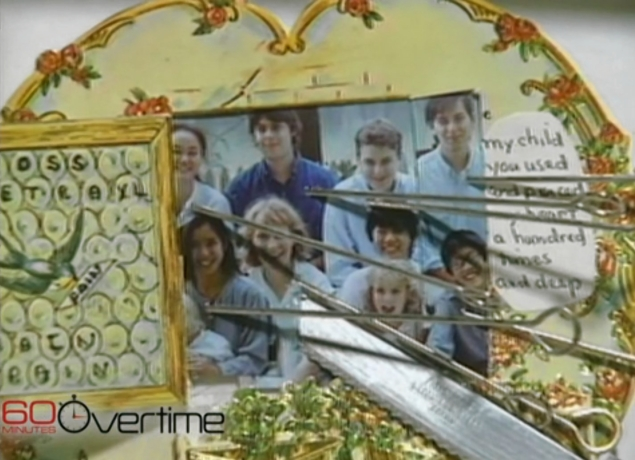
Her rage was understandable even if the Valentine was perhaps a touch dramatic. Among the rabble, there was this natural inclination to wonder how someone could fall in love with a young woman they had known since childhood. There were temptations to speculate on the degree to which Allen was a “father figure” to Soon-Yi. The dynamics here were unusual, but there were some mitigating realities stemming from something close to a fact: The vast majority of people commenting on the matter over the years have been ignorant of just how truly unusual was Mia and Woody’s relationship. There were demonstrably strange idiosyncrasies, such as the seeming fact that, in 12 years, the highly idiosyncratic Allen never spent a single night at Farrow’s New York apartment. There are many explanations for this that I haven’t the inclination to cover, but it seems Allen and Previn essentially completely ignored one another until she was an adult. They had no relationship at all. Farrow often complained that Allen ignored her children from her former marriage to Andre Previn. And Soon-Yi was apparently very lonely at college. So it was Mia Farrow, in fact, who prompted them to finally spend some time together upon one of her breaks. They both claim not even to have liked one another. They went a Knicks game. That, apparently, was that. Soon thereafter they were in love. As all parties were consenting adults, it was none of the public’s business. Mia Farrow obviously made it very, very public and without any understanding of the dynamics, everyone had opinions.
A custody battle between Mia and Woody over Satchel (aka Ronan) and Dylan almost immediately followed. Mia and Dylan claim it was at this time, and in this context– one where even Ronan and Dylan’s doctor, Susan Coates, explained in testimony that she “understood from Mr. Allen that Miss Farrow had repeatedly called him and said <…> that she wanted to kill him”– and in a home full of people understandably furious at him and instructed to watch his every move that, for some reason, within 5-20 minutes at most, for the first and only time, the claustrophobic Allen decided to abscond with Dylan Farrow into an attic crawlspace and touch “her private parts” for a few moments to no evidentiary degree, only return downstairs, rejoin the family and, upon her return from shopping, go out to dinner with Mia Farrow.
Now, the Soon-Yi affair didn’t happen in a vacuum. Woody Allen was a major celebrity. It was a tabloid scandal, a sensation. Questions stemming from Allen’s decisions during this time are, to my mind, the actually relevant questions when it comes to the art-and-artist line of inquiry as pertains Woody Allen. The other, far more troubling abuse allegation I will argue is not the least bit relevant when assessing Allen’s films except inasmuch as the accusation is almost certainly false, and the pain and resentment this must have caused both Woody and Soon-Yi certainly does show up in the films Allen made from 1994 until the end of his career.
I want to present my line of thinking as to this injustice– which I unhesitatingly call it– and hopefully before you throw your device across the room. Afterward, I want to discuss the ramifications of it in a few ways.
These are but six of what seem to be the key facts (there are many more) regarding Mia/Dylan Farrow’s accusation:
1. First, because it was used as character-evidence: Soon-Yi Previn was no victim, (unless you mean of Mia Farrow, but more on that later). The 21 year-old, by her own account, reciprocated every bit of love Allen had for her. To even state it that way is to diminish her agency. They fell in love with each other. How else to explain that twenty-five and more years later they are still married and with two adopted daughters of their own, both of whom adamantly defend their father. There hasn’t been a trace of evidence that Allen has had any extramarital relationships, nor anything that would indicate “an unhealthy interest in young girls”– a phrase you find in essentially every criticism of the man. If he did, after the almost slavering public desire to impugn him, it almost certainly would have been found. I think, as far as the art-and-artist discussion goes, this is a very important fact to acknowledge, given Woody’s tendency to portray human desire and romantic loyalty as fickle and capricious. He dated Mia Farrow for 12 years. Then he fell in love with Soon-Yi Previn and they’ve been married since 1997. He seems– at least later in his life– to live a life of real stability.
2. The accusation was initially vague and contradictory. It’s changed in circumstance, location, action, until it has at last settled, and there is some very strong evidence that– perhaps using a Nanny as a “witness” to something else, in fact– Mia brought the notion to Dylan, who initially denied it, but relented in the face of Mia’s insistence. Even trying to specify the initial accusation– and not confusing it with the several non-factual variations on the purported crime– is often difficult when researching it. Even the act that Dylan claims is, under the circumstances of which the event is supposed to have occurred, something Allen could have done seemingly anywhere, at nearly anytime before.
3. Probably the most important fact here: The Child Sex Abuse Clinic of Yale/New Haven Hospital performed a very thorough investigation and concluded that Dylan was probably coached or influenced by Mia Farrow, in particular to record a video that, many years later, resurfaced in the documentary “Allen v. Farrow” as the “nail in the coffin” of both the public’s doubt and Allen’s legacy. Yale/New Haven found “no credible evidence” of the accusation. Their language is very clear:
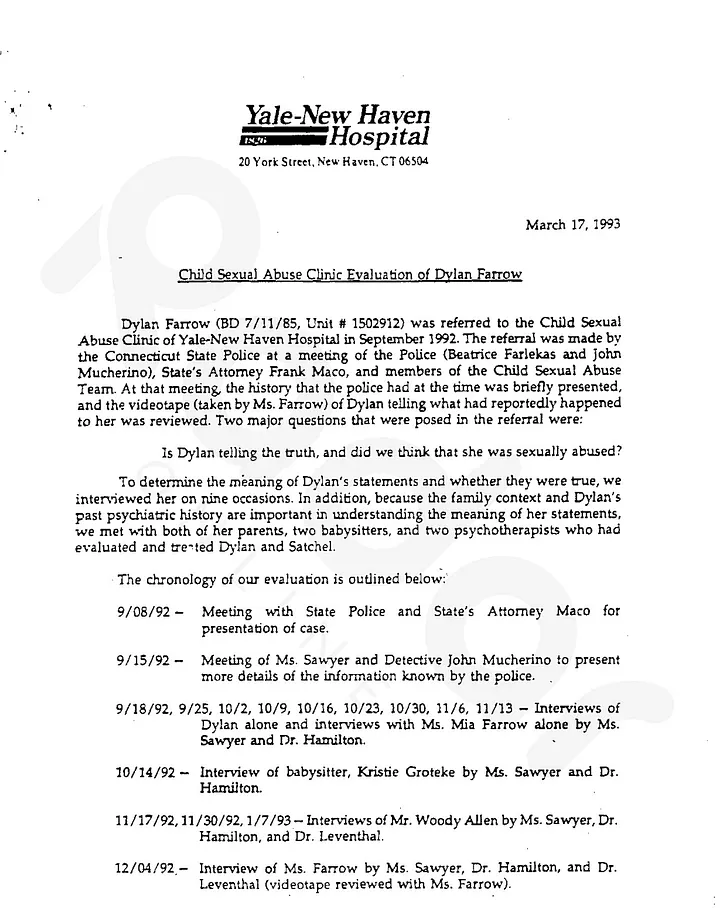
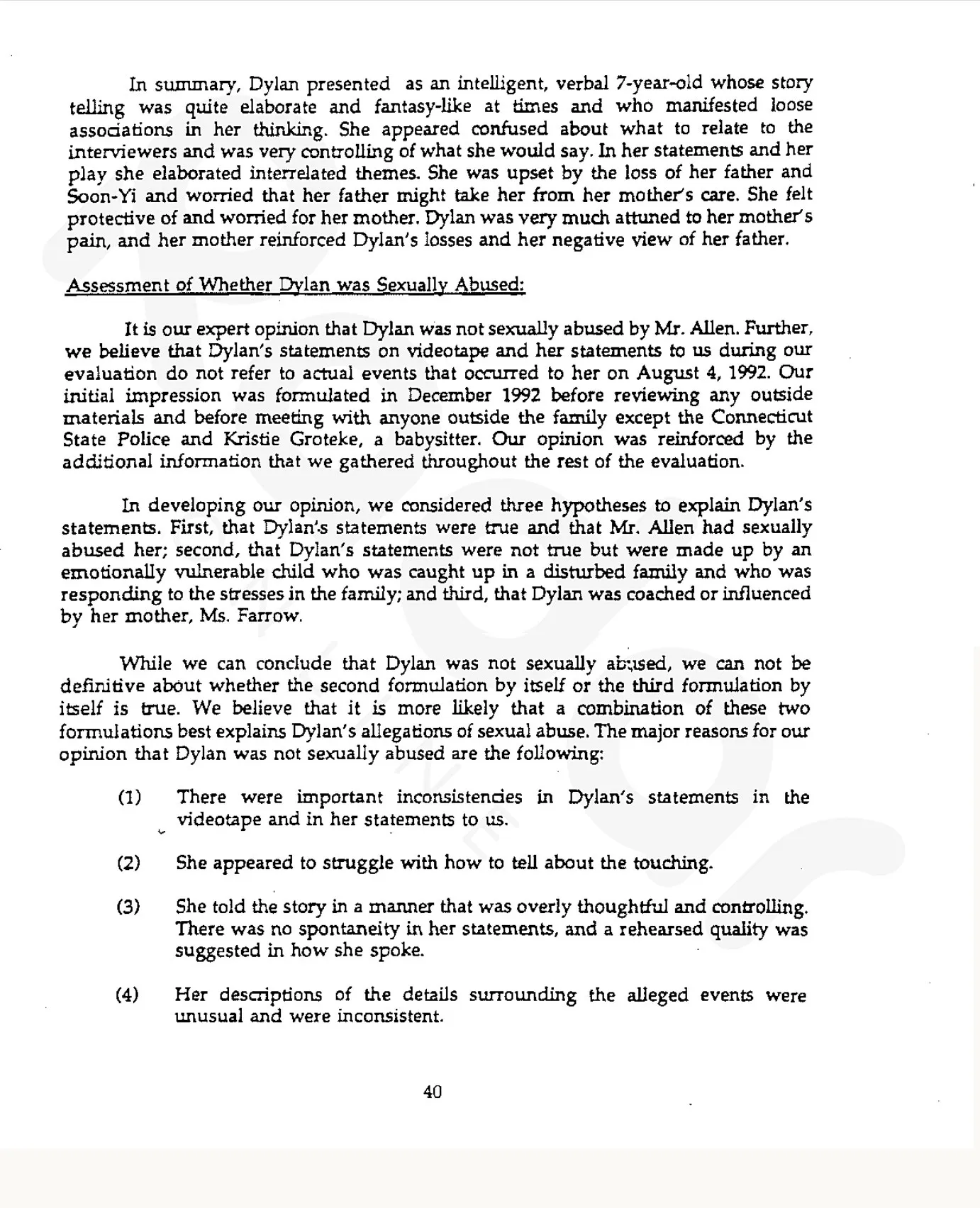
The Farrows have tried to suggest there were major failings, even malpractice, in this investigation. Not a single complaint holds weight under scrutiny. And it was later investigated once more by New York State Child Welfare Services, who concluded yet again: “No credible evidence was found that the child named in this report has been abused or maltreated. This report has, therefore, been considered unfounded.” The Farrows have never said a word about this second decision. Finally, the full statement dropping the case by the Connecticut State Prosecutor, Frank Maco, who was overtly hostile to Allen, includes: “To risk the well-being of a child in a case where there is evidence which points to the existence of a reasonable doubt (my emph.) is nothing less than to sacrifice the child on an altar of public spectacle.” This is seldom admitted by Dylan’s supporters who tend to parrot the “probable cause” element of the statement without understanding what that means legally. This statement is effectively the legal equivalent of, “I really hate to admit this, but I have no case, but would still like you to maintain your suspicions,” and Maco was greatly criticized by legal professionals at the time for the irresponsible wording.
4. There is not and has never been– not even from the Farrows– any clear accusation or recollection of any other crime or impropriety leveled at Allen before or since. The other “observations” cited in the documentary “Allen v. Farrow”, as just one example, are questionable at best (e.g., the “finger sucking” claim), irresponsible flights-of-fancy at worst and, to the shame of critics who seemingly forgot all notions of documentary ethics, come only from the Farrows in circumstances involving the Farrows.
5. Dylan Farrow has had the right (and still does) to press civil charges against Woody Allen in the state of New York.
6. Both Soon-Yi Previn and Moses Farrow have accused Mia Farrow of child abuse. Their accusations are severely disturbing. Moses: “She even shut my brother Thaddeus, paraplegic from polio, in an outdoor shed overnight as punishment for a minor transgression.” Thaddeus later committed suicide in 2016. He shot himself in his car, 8 miles from Mia’s home. Moses also accused Mia of “coaching” Dylan in exactly the manner Yale/New Haven suggested: “So many times I saw my mother try to convince her that she was abused—and it has worked,” the elder (14 to her 7, at the time) Moses tweeted in 2020. Moses Farrow’s account of his childhood in the Farrow household, “A Son Speaks Out,” from which I cited the above incident involving Thaddeus Farrow, is a harrowing document. Moses’ accounts and Dylan’s account are forcefully at odds. In it, he mentions something perhaps telling: “After I spoke to People magazine in 2014 about how I was treated, Dylan called it a “betrayal” and said that I was “dead to” her. She later publicly dismissed my recollections of my childhood as “irrelevant.” This from a woman who now styles herself an ‘advocate for abuse victims.'”
I wrote of an “interesting dynamic” above. By “interesting”, I mean in the context of those who are advocates of a “believe the victim” policy (by which they truly mean “believe the accuser”), and so are inclined to believe Dylan Farrow without reservation. I personally think this stance– as a heuristic for how those regard potential victims when they have no involvement in the matter– normally makes some practicable sense, given the oft-cited paucity of resources dedicated to, for example, investigating rape allegations, to the neglect of even collected physical evidence. Accusers often never get anything close to justice. At the very least, any such accusation should be treated with maximum seriousness by those professionals responsible for analyzing and investigating the evidence, and it would be downright strange (and highly suspect) for anyone to cast doubt on the accusation without involvement or information. There is an imbalance in care and fairness in our society regarding how sexual abuse allegations are investigated and there is much anger about this. The anger not only makes sense, it seems inevitable. #MeToo’s emergence was messy and fraught, but it was also natural and sensible and just. That anger had been building for decades, if not centuries. Decades, at least, as pertained its most heinous subjects in Hollywood. I also think, however, that as a heuristic, as a “good enough” assumptive framework, the decision to believe accusers should necessarily be accompanied by a tendency toward humility. In other words, it doesn’t compute that one’s forceful condemnation of the accused should automatically follow.
Why? Because here’s the rub: When the #MeToo movement first erupted and the allegations of Dylan Farrow were rekindled by Ronan Farrow, and then shortly thereafter with op-eds and media appearances by Dylan herself, the general gist of their argument was: If Bill Cosby and Harvey Weinstein, then why not Woody Allen? The implication was that, like Cosby and Weinstein, the press and Hollywood at large enabled Allen’s predatory behavior and essentially helped him avoid the punishment he deserved. That the exact opposite is true is case-in-point that the Farrows were in large part relying on the combination of the public’s ignorance of the facts and its discomfort with Allen following the Soon-Yi affair. This, to speculate, was probably Mia Farrow’s initial plan. In 1992, as a matter of character, you could hardly have stood up in front of courts and the public a more challenging figure than the director of Manhattan, whose new girlfriend was 36 years his younger and his former girlfriend’s daughter to boot. And so she tried. But Dylan’s accusation was, in fact, investigated to what even the most passionate victims-rights-advocate would admit was an almost absurdly thorough degree, especially in relation to such cases leveled by regular working citizens. Dylan Farrow got the most earnest response plausible (a multimillion dollar cottage industry sprung up around the case) and the Farrows as a family have received almost ceaseless glowing press coverage and a more-than-sufficient sense of collective victimhood from the public at large ever since, even though not a shred of evidence supported their claim. Not to mention their ability to shove the matter back into the public dialogue so forcefully more than two decades later.
“Why shouldn’t I want to tear him down?” Dylan asked– with a startling degree of vindictiveness more than 25 years later– in an interview on “60 Minutes” in 2018. “Why has the #MeToo Revolution Spared Woody Allen,” was the title of her op-ed in the LA Times. Fair, should her claims be true. But her accusation was deemed “not credible” by respected child abuse investigators when it happened. Because of this, charges were never pressed. Exactly what else is she suggesting should have been done by others? What is she suggesting of the individuals responsible for investigating her claims? What is she suggesting we should now do? Should we erase Allen from cinematic memory? With respect to the possibility of their sincerity, has any Farrow ever thought through the ramifications of that precedent? Certainly not Ronan, who, in 2020, pressured Hatchette Publishing to drop the publication of Allen’s memoir, “Apropos of Nothing”.
So I press the question: Which is more likely? Dylan’s accusation that Allen decided at this fraught time and in this incredibly unusual place to molest his 7-year-old daughter so carefully that there was not a single trace of evidence to be found? Where she claims to have communicated it to an already enraged mother in the midst of a custody battle with the very accused, and who instead of calling the police, proceeded instead to record her 7-year-old daughter on videotape for a series of days and, when she did not get the results from this that she wanted, let it sit for more than 20 years until the opportune moment came along to re-try her case in the court of public opinion and in such a way so as to imply that every legal channel failed her? Or the accusations (plural) of Moses and Soon-Yi Farrow with all of their attendant implications?
The very fact that this question can be pressed– that there is from a direct witness to the goings-on of August 4th, 1992 not only a contradiction of the claim in itself, but an unqualified and credible confirmation replete with extreme detail of the suspicions of the Yale/New Haven investigative team– seems almost dispositive. There is a very high chance that Dylan was a childhood victim of a different order. She was a seven-year-old caught in the crossfire of profound family and legal acrimony. At some point– who knows when?– she seems to have grown convinced that this happened to her, even though at the time she was sufficiently unable to convince two separate teams of child abuse investigators that it had, and by this I mean that she seemed not even to demonstrate trauma that would raise their alarm. She certainly can’t reverse her claim now, and why would she? It’s understandable the Farrows would despise Woody for the Soon-Yi affair alone.
So we move on to some of those unsurprising and quite revealing ramifications:
There were hundreds of articles written since Ronan Farrow hijacked the #MeToo movement to push the family agenda where former Woody fans and idolators “reassessed” their own “complicity” in the greater cultural abetment. Dozens of professional critics and hundreds of amateur cinephiles betrayed that they hadn’t the least capability of nuance in discussing art and life. They also began revising their takes on Allen’s films to the extent of undermining the future reliability of their criticism. One of the most revolting was A.O. Scott’s remarkably self-aggrandizing, “My Woody Allen Problem,” in the New York Times, in January of 2018, some four months before Moses posted his searing account. Scott wrote as if he was the arbitrating voice of cultural morality at large commenting on a settled matter, and not just a once decent film critic. “Mr. Allen’s films and writings are a part of the common artistic record, which is another way of saying that they inform the memories and experiences of a great many people. I don’t mean this as a defense, but an acknowledgment of betrayal and shame.” Self-righteous almost to priggishness. One can only hope Moses Farrow caused him at least a bit more, fresh shame. Did the films change? Or was Scott admitting that his criticism was valid only insofar as his takes remained popular? “Part of the job of a critic — meaning anyone with a serious interest in movies, professional or otherwise — is judgment, and no judgment is ever without a moral dimension,” he wrote. I agree with this, but his position doesn’t comport with half of what this “seriousness” implies. Certainly, to be a good critic, nuance is required in artistic and aesthetic judgment. Is the same nuance not required in moral judgment? Is the job of the critic to parse up artistic efforts with the keen eye of a sanctimonious idiot? Perhaps the wrong question to ask the chief film critic for the New York Times, but I ask nonetheless.
Another instance had the New Yorker’s reliably pretentious Richard Brody writing one of the most deliriously full-of-shit retcons in the history of film criticism: “It wasn’t until “Crimes and Misdemeanors,” from 1989, that I grew disgusted with Allen. In the film, he plays a documentary filmmaker named Cliff whose most substantial and serious intellectual and personal relationship is with his niece, Jenny (Jenny Nichols), whom he takes to watch classic movies at the late, lamented Bleecker Street Cinema, and to whom he pontificates cheerfully, innocently—basking in her admiration while hardly giving her a chance to speak. Nothing illicit whatsoever is depicted or implied. Yet Cliff’s intense interest in Jenny struck me, when I first saw the movie, as an oblivious surrogate for a romantic relationship, and I was repelled both by the movie’s tone and by Allen’s apparent lack of awareness of the implications of what he was both depicting and enacting.” (both emph. mine). What, pray tell, are the implications of what Allen was “both depicting and enacting”? Oblivious surrogate for a romantic relationship? Mr. Brody should avoid all movies about a person and their dog– he’ll have an aneurysm. Was he disgusted by what Kelly Reichardt was “depicting and enacting” in Wendy and Lucy? I mean, Wendy was devastated at the parting, as was I– more so than probably 90% of the breakups “enacted” in Woody Allen films– and I don’t even particularly like the movie. In those films is an unavoidable sense of an oblivious surrogate for a romantic relationship, but they don’t, it must be said, tend to molest the dog. Ever.
Similarly the host of actors and actresses– among them Mira Sorvino, Elliot Page, Greta Gerwig, Timothee Chalamet, Rebecca Hall and several others– who made self-aggrandizing public statements of regret for working with Allen. They had every ability to read, or simply to stay silent, such as Elle Fanning did. Some of them even went as far as the empty gesture of “donating” their salaries to advocacy organizations– empty in that Allen’s actors always worked for scale (read: not much) and that the money was to them pretty much meaningless. This is yet another way of speaking of those on the peripheries of this whole affair. These people are not like you or I. These people can toss away money and fairness because it’s an inexpensive public relations move for the betterment of their careers. They care as much about this Dylan as about Bob. But, in a way, they had to do this. The matter had become political, emerging most alarmingly in a frightening nadir perhaps best typified by an article in the journal “Forward”, titled “How Should People Apologize for Working with Woody Allen?” by a young woman named Jenny Singer, an MFA at the Iowa writing program. Here she analyzes the contemporaneous apologies in terms of how Moses Maimonides, the legendary rabbinic scholar of the 12th century, would “score” them, and caps her article with a list of “People We’d Like To See Reflect Publicly On Their Choices To Work With Allen.” It’s actually tough here to see the tongue in the cheek. It might not be there. Consider the degree of sanctimony required to compile a list of people who you feel owe apologies merely for working with someone.
One last, ramification that is most disturbing because there is the matter of the existential to it: There are many circumstances where Woody Allen’s work, now falling into public disrepute, is– like “Apropos..” was only momentarily– being erased-by-default by falling from streaming and rental services. Executing this project has been extremely difficult and expensive. It is, as of this moment for example, close to impossible to watch Mr. Brody’s dreaded Crimes and Misdemeanors anywhere. I simply could not find it and was forced to spend $40 on an old DVD copy. The same for Zelig. Any cinephile, regardless of stripe, should be alarmed by this. As anyone who has lived long enough to have passed through mediums (not from corporeal to heavenly, but rather from videotape, to dvd, to blu ray, to streaming, etc.) knows: time erases everything. Things are lost. Or they become inaccessible to the point that they might as well be gone. Will this truly happen to Allen’s films? I don’t know. No one does. But there will certainly not be any particular business urge to produce updated box sets of Allen’s work anytime soon. The old box sets (I gave mine away years ago, sadly) go for a fortune online. That may goad someone, but that brave soul will have to deal with the Farrows and their minions who, of course, fight only for sexual abuse victims everywhere:
“I’m glad my mother believed me when I was sexually assaulted at 13. She asked me once, “Was it true?” and then called the police on the spot. She didn’t first videotape me over a series of days for proof. Worked out much better for my family that way, and that is one low fucking bar.”
– a 2021 tweet by Samantha Geimer, who was raped and sodomized by Roman Polanski, in 1977, the year of Annie Hall. Mia Farrow is on record defending Polanski. He gave Mia her breakout role in Rosemary’s Baby in 1967 when she was only 22, to the chagrin of her possessive 53-year-old husband, Frank Sinatra. They soon divorced. (edited for clarity)
That’s enough. If you are still understandably conflicted or disgusted I get it– it’s a snake-pit, a hornets-nest of ugliness in so many ways and on both sides. The taint of the accusations is unavoidable even reckoning with facts, ultimately because after one tallies them the most forcible fact is that we will never truly know what happened that day. This is why, though it was remarkably unenjoyable, I quickly realized I would have to address the accusation and my position. If you are still uncertain whether to taint your reading of the never-unchallenging, never-uncontroversial but still bounteous gift that is the cinema of Woody Allen, I refer you to the dedicated citizen journalism of Rick Worley and Robert B. Weide. I only hope that, in the improbable event one might be reading this 10 or 20 or 30 years from now, that all of Woody Allen’s films can still be found and that this branch of my project was not in vain.
 films and filmmakers